Best Pokie Machines to Play in Australia: A Practical Guide
 Available in AU
Table of Contents
- Online Pokie Machines in Australia: Availability and Legal Boundaries
- What Is a Pokie? Definitions, Features, and Market Presence
- Physical Pokie Machines: Design, Mechanics, and Gameplay
- Free Pokie Play: Demo Modes and No‑Money Options
- Pokie Odds and Player Return: How the Numbers Work
- Pokies in Australian Casinos versus Pubs and Clubs
- Popular Pokie Game Themes and Variations
- Playing Pokies for Real Money: Key Considerations
- Pokie Machine Apps and Digital Integration
- Practical Tips to Improve Your Pokie Experience
Online Pokie Machines in Australia: Availability and Legal Boundaries
I spent years around the industry side of gaming floors, and the question I get asked most by people searching for a pokie machine online is always the same: why can I find real-money slots in a UK or Malta casino review but not one licensed here. The short answer is that no such licence exists. The longer answer explains the mechanics behind that gap.
The Interactive Gambling Act 2001 makes it an offence for an operator to offer real-money gambling to Australian residents online. That’s the operator’s problem, not a technicality buried in fine print for players to worry about. The law was built to sit on the supply side. It doesn’t criminalise an Australian resident for opening an account with an offshore site, but it does mean there is no domestically licensed real-money online pokie machine product to point to. Any site claiming to hold an Australian licence for online slots is telling you something that cannot be true, because that licence category doesn’t exist here.
If you’re hunting for a solid spot to spin pokies in 2026, the operators below are worth a quick look before you sign up, so you can weigh bonuses, deposit limits and payout speeds at a glance.
License: international iGaming licence – jurisdiction not named in the source · Bonus: 100% up to A$1,000 + 100 free spins, 35x wagering · Payout speed: PayID 1-24 hours · Min. deposit: A$30 (PayID from A$10) Holds an international iGaming licence and offers a generous welcome package with free spins, plus fast PayID withdrawals for those who prefer quick access to their funds.
License: Curacao – Antillephone N.V. (Versus Odds B.V.) · Bonus: up to EUR 2,000 across 5 deposits + 200 free spins · Min. deposit: EUR 20 Licensed in Curacao under Antillephone N.V., this operator spreads its welcome bonus across multiple deposits, giving players extra value over their first few sessions.
License: Curacao eGaming OGL/2023/174/0082 (Dama N.V.) · Bonus: up to A$10,000 + 500 free spins across 4 deposits · Min. deposit: A$15 Operating under a Curacao eGaming licence via Dama N.V., it stands out with a sizeable multi-deposit bonus and a low minimum deposit requirement.
Bonus: up to A$7,500 + 550 free spins across 10 deposits, 50x wagering · Payout speed: crypto under 1 hour, PayID 1-3 business days · Min. deposit: A$20 (A$30 to qualify for the bonus) Offers a large bonus package spread across ten deposits, with crypto withdrawals processed quickly and PayID payouts available within a few business days.
Bonus: 100% up to A$750 + 200 free spins, 35x wagering · Payout speed: crypto 30-120 minutes, fiat 24-72 hours · Min. deposit: A$30 Provides a straightforward welcome bonus with free spins, backed by fast crypto payouts and reasonably quick fiat withdrawal times.
License: Curacao Gaming Control Board OGL/2023/176/0095 (Hollycorn N.V.) · Bonus: up to A$11,000 + 300 free spins (code NEO100) Licensed by the Curacao Gaming Control Board through Hollycorn N.V., it offers one of the larger bonus amounts on this list, redeemable with a promo code.
License: Curacao Gaming Control Board (TechSolutions Group N.V.) · Bonus: 100% up to A$250 + 100 free spins (1st deposit) A Curacao-licensed operator run by TechSolutions Group N.V., offering a simple first-deposit bonus with free spins for newcomers.
License: Curacao Gaming Authority (Jumpman Gaming Ltd) · Bonus: up to A$6,600 + up to 250 free spins across 4 deposits Licensed under the Curacao Gaming Authority via Jumpman Gaming Ltd, it provides a solid multi-deposit bonus with a decent number of free spins attached.
License: Curacao OGL/2024/1335/0780 · Bonus: up to A$1,000 + 150 free spins, wager-free · Min. deposit: EUR 20 Operating under a Curacao licence, it offers a wager-free bonus structure, which can appeal to players who prefer fewer strings attached to their spins.
License: Curacao eGaming (Hollycorn N.V., since 2017) · Bonus: 225% up to A$1,540 + 600 free spins across 4 deposits, 20x wagering · Min. deposit: A$20-30 (depends on the offer) Licensed by Curacao eGaming through the long-standing Hollycorn N.V., it features a large percentage match bonus spread over several deposits with a comparatively low wagering requirement.
This matters because "online pokie machine games" as a search phrase covers a lot of very different products, and they don’t all sit on the same side of the law.
What’s actually legal to access online
- Free-play and demo versions of pokie-style games, run without real-money stakes, are not gambling under the Act and are widely available.
- Sports and race betting operated by state or territory-licensed bookmakers is legal online.
- Lotteries licensed at state or territory level are legal online.
- Real-money online pokies, poker, blackjack, roulette and live-dealer casino games are prohibited outright, regardless of who is offering them or how the site is branded.
So when someone types "pokie machine online" hoping to play for cash, what’s legally available to them domestically is nothing — not a restricted version, not a scaled-down version, nothing. What is available, and legally so, is the free-to-play layer sitting on top of the same game engines, plus the wagering and lottery products the states do license.
Offshore sites and the player’s actual position
A separate question is what happens when a resident signs up with a foreign-licensed operator anyway. The Act was written to target operators, not players, which is why nobody gets prosecuted for placing a bet with an offshore site from a lounge room in Brisbane. That’s often misread as tacit approval. It isn’t. It’s a gap in enforcement design, not a green light. The operator is breaking Australian law by accepting that resident; the player isn’t breaking it by logging in. Those are two different legal positions, and conflating them is how a lot of misleading "play here legally" claims get written.
I’ve seen review sites lean hard on that gap — technically true, framed to sound like a loophole worth using. It isn’t a loophole. It’s an unregulated environment, which is a different thing entirely. There’s no domestic licence, no domestic dispute process, and no regulator here who will hear a complaint about an offshore operator’s payout behaviour. Whatever protection a player has comes entirely from wherever that operator is actually licensed, if anywhere.

How online availability differs from the machine on the pub floor
Land-based pokies in pubs, clubs and casinos operate under a completely separate licensing structure at the state and territory level — that’s the world of physical cabinets, venue rules and cash handling, covered elsewhere in this piece. The online prohibition doesn’t touch that ecosystem at all. A machine sitting in a licensed venue is legal by design; the same game reskinned into an app or a browser client for real-money play, offered to an Australian resident, is not — not because the math or the reels are different, but because the delivery channel is the thing the law regulates.
That distinction trips people up constantly. The game itself — the reel set, the paylines, the bonus round — isn’t what’s being restricted. It’s who’s allowed to accept the bet and from where. A provider can run identical software in a licensed land-based cabinet and an unlicensed offshore web client. Same math model, same paylines, opposite legal status, purely because of the channel and the licence attached to it.
Illegal Real‑Money Play
Playing real‑money pokies online as an Australian resident breaches the Interactive Gambling Act 2001 and can expose operators to heavy penalties. Players are not prosecuted, but the service is illegal.
The money side, briefly
The volume moving through electronic gaming machines in this country is not small. In the 2020-2021 financial year, Australians placed bets worth almost AUD 150 billion on electronic gaming machines — a figure from land-based play, since that’s the segment with formal reporting, but it gives a sense of scale for a market where the online real-money layer is legally closed off entirely. Whatever a player does manage to win, through any legal channel, isn’t taxed on the player’s side. Gamblers’ winnings in Australia are not taxed. That’s one of the few genuinely simple facts in this whole area — no forms, no thresholds, no reporting obligation for the punter. What operators owe the states is a separate matter entirely, and it varies by jurisdiction and by product type, which is its own tangle not worth flattening into a single line here.
Where that leaves someone searching for a pokie machine simulator or free-play option
If the intent behind a search is to try the mechanics, check paylines, or get a feel for a bonus structure without wagering real money, that’s the legal and available path online in Australia right now. If the intent is real-money play through a locally licensed site, that product doesn’t exist, and no amount of clever wording on a review page changes that. Anyone offering "licensed online pokies" to an Australian audience is either talking about a licence issued somewhere else entirely, or not talking about a real licence at all.
Worth saying plainly: there’s no official public register in Australia to check an online casino licence against, because the licence category itself doesn’t exist domestically. That’s not a gap in this article — it’s a gap in the market.
What Is a Pokie? Definitions, Features, and Market Presence
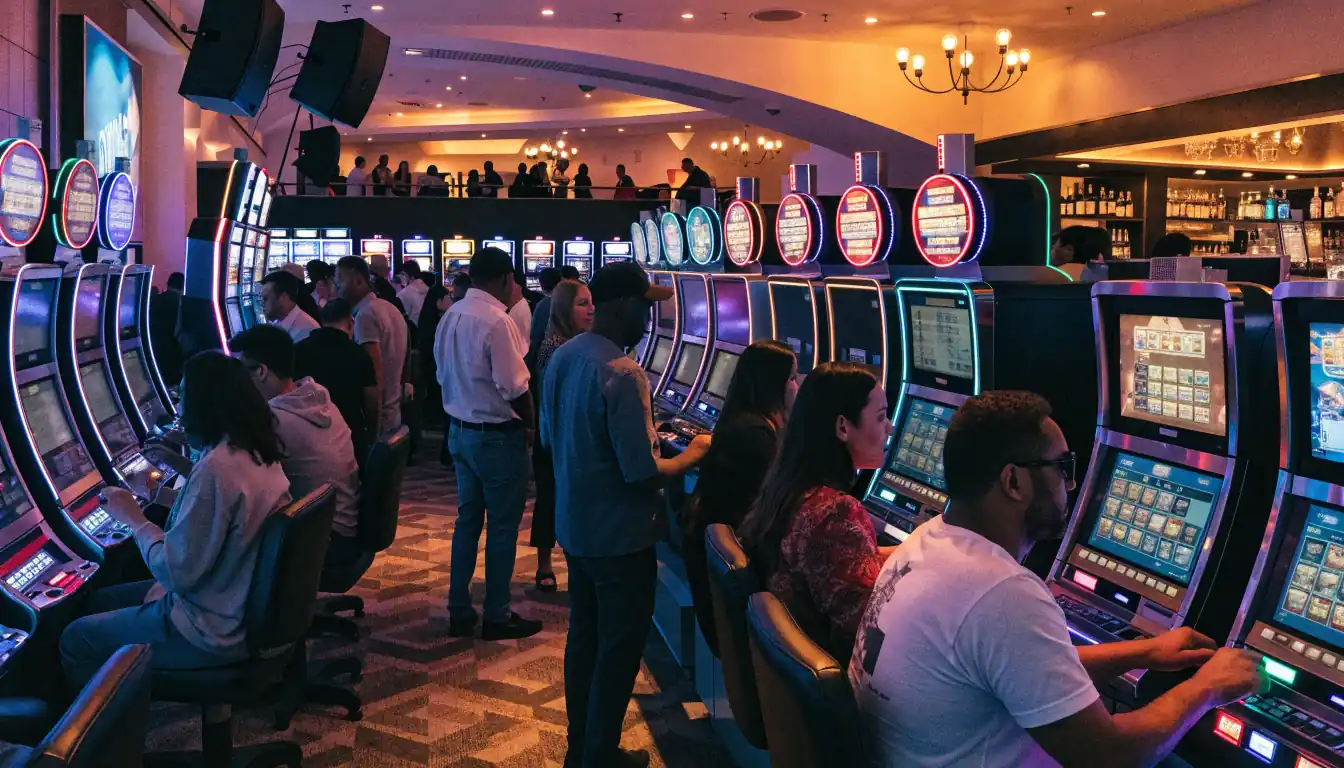
"Pokie" is just Australian shorthand for a poker machine — the slot cabinets that sit in the corner of every pub, club and casino floor from Perth to Cairns. Nobody in the industry actually calls them poker machines out loud. On paper, in the regulatory filings, they’re electronic gaming machines, EGMs. In conversation, they’re pokies. I’ve heard venue managers correct themselves mid-sentence because the formal term sounds foreign coming out of their own mouth.
The mechanics haven’t changed much in spirit, even as the hardware has. A pokie takes a bet, spins a set of reels or triggers a digital equivalent, and pays out according to a program sitting inside it. What varies is the dressing: the theme, the number of lines, the bonus round gimmick bolted on top. Strip that away and every pokie is doing the same job — converting a queue of small, fast bets into a result, over and over, thousands of times a session.
Where they actually sit in the market
Electronic gaming machines are operated in every Australian state, plus the Australian Capital Territory and the Northern Territory. There’s no jurisdiction where you won’t find them. That uniformity is worth sitting with for a second — it means the pokie isn’t a niche product tucked into casino floors. It’s furniture. It’s in the RSL down the road, the bowls club, the front bar of a suburban pub that otherwise looks nothing like a gambling venue.
How big a slice of the global pokie fleet does Australia represent? Here the sources don’t agree with each other, and I’m not going to paper over that. One figure puts Australia at 3% of the world’s pub and club poker machines. Another, cited elsewhere, claims Australia holds something closer to 18%. Those numbers describe very different countries — one where Australia is a minor player, one where it’s punching wildly above its population. I can’t tell you which is right, and neither can most of the industry commentary that repeats one or the other without checking. What I can tell you is that regardless of which figure you believe, the density on the ground — machines per pub, per club — is high enough that most Australians have grown up walking past them.
What actually loses money
The scale shows up in the loss figures more clearly than in any percentage-of-world-fleet argument. In the 2020-2021 financial year, the total player loss from electronic gaming machines across Australia was about AUD 12 billion. That’s not turnover, not bets placed — that’s the net gap between what went in and what came back out, across every state and territory combined. A number that size doesn’t happen from a handful of destination casinos. It happens because pokies are everywhere, played in small increments, by a large number of ordinary people, most sessions.
The features that make a pokie a pokie
Wind back to basics and a pokie has a short list of characteristics that show up regardless of theme or venue:
- A fixed pay structure programmed into the machine — the outcomes aren’t decided by a dealer or a live event, they’re generated by the machine itself.
- Multiple betting lines or ways to win — modern cabinets rarely run a single payline; the “ways” multiply how a spin can land.
- A bonus feature layer — free spins, multiplier rounds, or a wheel bonus sitting on top of the base game, usually the part the marketing leans on hardest.
- A denomination and bet-size range set by the operator — you choose how much goes in per spin within whatever band the venue has configured.
- A rapid bet cycle — spins resolve in seconds, which is part of why the loss figures accumulate the way they do.
None of that is unique to Australia. What is distinctly local is the word itself, and the sheer normalisation of having one within walking distance of almost anywhere you live.
A term that hides its own mechanics
"Pokie" sounds almost affectionate — a diminutive, something small and harmless. That’s not an accident of language, it’s a gift to the industry that nobody had to ask for. Call something a "poker machine" and you’re admitting it’s a gambling device with a payout structure. Call it a "pokie" and it sounds like a fixture, like the jukebox or the pool table.
I’ve sat in venue meetings where the word choice mattered more than people admit. Nobody says "come lose money on the gaming machine." They say "have a go on the pokies." Same object, same odds, different weight.
Worth being precise about the two labels people actually use:
| Term | Where it’s used | What it implies |
|---|---|---|
| Pokie | Everyday speech, pubs, clubs | Familiar, low-stakes framing |
| Electronic gaming machine (EGM) | Regulatory documents, statistics | Neutral, technical framing |
They describe the exact same cabinet. Choosing one over the other doesn’t change the machine — only how it lands in the room.
Physical Pokie Machines: Design, Mechanics, and Gameplay
Walk into any venue with a gaming licence and the machines look interchangeable from a distance — same cabinets, same glowing buttons, same looping jingle. Up close they’re not. What sits inside a physical pokie machine is a purpose-built computer running a random number generator, wired to a note acceptor, a printer for redemption tickets, and a screen that’s really just the front-of-house display for a decision made elsewhere in the circuit. The lever is theatre. Nobody’s pulling anything that changes the outcome.
I spent enough time around venue floors to know the cabinet itself is chosen for reasons that have nothing to do with the game inside it. Footprint, noise level, how it looks under venue lighting, whether the seat invites someone to stay for an hour instead of ten minutes. The mechanics that matter — reel count, paylines, bonus triggers — are locked in firmware and don’t change once the machine is certified and placed on the floor. That’s the part the industry doesn’t advertise: the "exciting new game" is usually the same math engine wearing a different theme.
Hardware versus the online experience
Where this diverges from the browser-based version covered earlier is the physical loop: cash or note goes in, credit appears on a physical meter, and any payout has to be physically redeemed — printed ticket, cashier, or (increasingly) a card system tied to the venue. There’s no app notification, no instant balance update on a phone. The machine itself is the interface, start to finish. Online play strips that hardware layer out entirely; here, the hardware is the experience.
Physical machines are also bound to a location in a way online play isn’t. Electronic gaming machines are operated in all Australian states, the Australian Capital Territory and the Northern Territory, which means the cabinet in a suburban pub and the one in a regional club are running under the same broad category of hardware regulation, even if the venue around them looks nothing alike.
What’s actually happening inside
- A random number generator determines the outcome the instant the button is pressed — not the reels spinning, which is animation layered on top of a result already decided.
- The note acceptor and ticket printer are certified components, separate from the game logic, and they’re what create the physical record of cash in and credit out.
- Progressive mechanisms — where a jackpot figure climbs across linked machines — run as a layer connected to multiple cabinets, pooling a portion of play into a shared prize pot rather than paying out from a single machine’s own turnover.
- Volatility and payout structure are set at certification and don’t shift based on time of day, how long someone’s been playing, or how a machine “feels” — a belief that persists on venue floors despite having no mechanical basis.
None of this is exotic engineering. It’s a slot machine’s logic wrapped in a locked cabinet, and the lock is as much regulatory as physical — venues can’t legally open these up and adjust them on a whim.
The part nobody prices out loud
People occasionally ask what a pokie machine actually costs a venue to buy or lease, treating it like any other piece of commercial equipment. That’s the wrong question to be asking as a player, because it points attention at the hardware instead of the outcome. The number that actually describes what these machines do sits elsewhere: in FY 2020‑2021 the total player loss from electronic gaming machines across Australia was about AUD 12 billion, working out to AUD 608 per capita that same year. That’s not a hardware spec. That’s the mechanism doing exactly what it was built to do, across pubs, clubs, and casinos where pokies are a fixture of the floor plan, not a novelty.
The cabinet is just the box. The economics are the actual machine.
Free Pokie Play: Demo Modes and No‑Money Options
Free play exists because the law drew a line, and demo mode sits neatly on the safe side of it. The Interactive Gambling Act 2001 makes it an offence for online operators to offer real‑money gambling to Australian residents — but nothing in that law bans a website from spinning reels for credits that never touch a bank account. No wager, no payout, no offence. That’s the whole loophole, and it’s not even a loophole, really — it’s the plainest possible reading of the statute. Once real money stops moving, the Act has nothing left to regulate.
I’ve spent more time than I’d admit clicking through demo builds while checking how a title behaved before it ever mattered financially. What I was actually testing was reel behaviour, not luck. Free mode runs on the same reel logic as the version people talk about wanting to try before paying — same reel count, same symbol sets, same near‑miss patterns. The software underneath doesn’t know the difference between a demo session and a funded one, because from the machine’s point of view there isn’t one. The credit meter is just a number with no consequence attached to it.
What demo mode actually shows you
Demo credits let you see:
- Reel and payline structure — how many reels spin, how paylines are arranged, whether the layout is a fixed grid or something looser.
- Bonus triggers — what sets off a feature round, and how often it shows up over an extended session.
- Volatility feel — whether wins come in a steady trickle or arrive rarely and large. You can’t get an RTP figure from watching, but you can get a sense of rhythm.
- Theme and presentation — the art, sound, and pacing, which is often the actual reason someone picks one machine over another.
None of that requires a dollar. And none of it tells you the return‑to‑player percentage, no matter how long you watch — RTP is a long‑run statistical property, not something a demo session reveals in an afternoon.
Why "free" isn’t the same as "yours to keep"
The catch, and there’s always a catch, is that free credits are exactly that: credits, not currency. They reset, they expire, they were never redeemable. This matters because gamblers’ winnings in Australia aren’t taxed — a genuinely player‑friendly rule — but it only applies to actual winnings from actual wagers. Play a demo to a million notional credits and the tax office has nothing to assess, because there’s nothing there. No money changed hands, so no money changed status. It’s not a tax dodge; it’s just not gambling in the sense the word implies.
This is where the marketing language earns its quotation marks. "Practise for free" sounds like training. What it trains you on is button placement and pacing, not odds — the demo can’t teach you anything about what happens when your own money is actually at stake, because the psychology of a free spin and a funded one aren’t the same animal wearing different clothes. I’ve watched people play flawlessly calm in demo mode and go completely different the moment real balance was on the line. The reels didn’t change. They did.
Free versions also serve a quieter function: they let a machine advertise itself without advertising gambling. A demo isn’t a wager, so a site can show off a title’s mechanics to an Australian audience without wandering anywhere near the Interactive Gambling Act’s restrictions. That’s a genuinely useful thing for players trying to compare mechanics between machines before deciding where, or whether, to spend anything.
What free play can’t do is substitute for the physical‑machine mechanics covered earlier, or answer the return‑to‑player questions that come next — a demo shows you the shape of a game, not its long‑term arithmetic.
Pokie Odds and Player Return: How the Numbers Work
Ask around a pub about which machine pays best, and you’ll get a dozen confident answers. Most of them are guesses dressed up as knowledge. I spent enough time watching the money move through these systems to know the honest answer is duller than anyone wants: the odds are built to take more than they give back, consistently, across the board, and no amount of watching a machine "run cold" changes the math sitting underneath it.
What the aggregate numbers show is the pattern at scale. In the 2020‑2021 financial year, Australians placed almost AUD 150 billion in bets on electronic gaming machines. Of that turnover, the total player loss came to about AUD 12 billion. That’s not money vanishing into a black hole — it’s the mechanical result of a return rate that’s built to sit below 100%. Turnover is what gets wagered and re‑wagered as it cycles through a session; loss is what’s actually left behind at the end.
Break that AUD 12 billion down per person and you get a per‑capita loss of AUD 608 for the year. That figure blends everyone — people who never touched a machine and people who played every week — into a single average. It’s not a prediction of what any one player will lose. It’s a snapshot of what the machines, in aggregate, extracted from the population that year.
Why the house edge doesn’t feel like an edge
The gap between turnover and loss is the house edge made visible. Sit at a machine for an hour and it can feel generous — small wins land often enough to keep the session feeling alive. That’s the design working as intended. Frequent small returns keep money in play longer, which is exactly how turnover balloons to numbers like AUD 150 billion while the actual loss stays a fraction of that. Neither figure tells you what happens in any single spin, and no combination of them tells you when a "hot" or "cold" streak is coming. There isn’t one, in the sense players mean it.
What the numbers are actually good for
Not predicting outcomes. Setting expectations.
Knowing that turnover dwarfs loss explains why sessions can feel like they’re going nowhere — money is cycling, not accumulating. Knowing the per‑capita figure gives a rough sense of scale, not a personal benchmark. Neither number tells you which machine to sit at. That question — the one buried in "best pokie to play" — doesn’t have an answer these figures can supply. The industry doesn’t publish machine‑by‑machine return data for public comparison, and no reliable source fills that gap.
Pokies in Australian Casinos versus Pubs and Clubs
Walk into a casino floor and the pokies sit alongside table games, under a licence that covers the whole venue as a single operation. Walk into a pub or a club and the pokies are usually the main event — a room, sometimes two, humming on their own. Same machines, broadly speaking. Different regulatory weight resting on top of them.
Casinos answer to a distinct layer of law. In New South Wales, an amendment to the Casino Control Act 1992 lets regulators fine casino operators up to AUD 100 million for compliance failures. That figure tells you something about how the state treats casino-floor gaming compared to a pokie room above a suburban pub — the exposure for getting it wrong is on a completely different scale, and the paperwork behind the scenes reflects that.
Pubs and clubs operate under state and territory gaming licences that are more numerous, more local, and — in practice — harder to police machine-by-machine simply because there are so many venues. Pokies are widely used across all three settings: pubs, clubs, and casinos. Nobody disputes that. What differs is who’s watching, how closely, and what the penalty looks like when something slips.
The cashless push
The clearest sign of where regulation is heading came out of the 2022 NSW Islington Report, which recommended moving all NSW pokies to cashless play by the end of 2028. Worth being upfront about the status of that number: it’s a recommendation from one review, not a locked-in deadline written into the Casino Control Act or any other statute I could point to. Treat it as direction of travel, not a date to bank on.
The logic behind it isn’t complicated. Cash-fed pokies leave no trail between the person putting money in and the money coming back out. Account-based, cashless systems close that gap. For casinos, which already run under heavier compliance obligations, moving to cashless machines is a smaller leap. For clubs and pubs, it’s a bigger structural change — new terminals, new player accounts, new habits at the bar.
None of this changes what a pokie actually does once you’re sitting in front of it. The reels spin the same way whether the room has a cashier’s cage or a bartender. What changes is the machinery around it — who audits the venue, what the fine looks like if they don’t, and whether the money you feed in today still has your name on it when cashless rules eventually land everywhere.
Popular Pokie Game Themes and Variations
Walk into any venue and the range of pokie machine games on the floor tells you something about how the industry actually grows. It doesn’t grow by inventing new mechanics very often — reel counts, paylines and bonus rounds have stayed roughly the same for years. What changes constantly is the skin on top: the theme.
Themes exist for one reason. Recognition sells faster than novelty. A player scanning a wall of forty identical-looking cabinets stops at the one that reminds them of something.
The themes that dominate the floor cluster into a few recognisable groups:
- Ancient civilisations — Egyptian, Greek and Roman motifs, built around pyramids, gods and treasure symbols.
- Wildlife and nature — Australian fauna, jungle settings, ocean life.
- Fruit and classic symbols — cherries, bells, sevens, styled after the earliest mechanical machines.
- Mythology and fantasy — dragons, wizards, fictional kingdoms.
- Pop culture tie-ins — licensed film, TV and music branding.
- Luck and fortune themes — four-leaf clovers, horseshoes, Irish or Asian luck iconography.
Underneath the theme, the "variations" that operators talk up — cascading reels, expanding wilds, hold-and-spin features, progressive jackpot links — are mechanical layers, not new games. Strip the graphics away and a lot of them reduce to the same underlying math with a different trigger condition.
None of this is small business. Pokies generated AUD 191.2 billion in gambling turnover in 2023, according to complyadvantage.com — a figure that reflects a market wide enough to support constant theme rotation without needing to change what’s actually happening under the glass.
Scale also explains why Australia’s share of the world’s machines gets reported inconsistently. One source puts it at 3% of the world’s pub and club poker machines; another puts the figure closer to 18%. That’s a large gap, and nothing in the available data resolves it — worth flagging rather than picking one number to sound authoritative.
Themes get marketed as innovation. Mostly they’re wallpaper.
Playing Pokies for Real Money: Key Considerations
Demo mode teaches you nothing about what real-money play feels like once your own cash is on the line. The moment actual currency leaves an account, the calculation changes — and so does the behaviour around it, which is exactly why regulators pay closer attention to this stage than to any other.
Start with the one piece of good news: winnings from pokies are not taxed in Australia. Whatever comes out of the machine is yours in full, no return to file, no percentage owed on a lucky session. That’s the player side settled.
The operator side is a different matter entirely. Taxation of gambling operators varies by state and by the type of gambling service offered, which is part of why a venue’s terms, floor layout and even machine mix can look different depending on which side of a state border it sits. There’s no single national rulebook operators follow — each jurisdiction sets its own arrangement, and that patchwork shapes what you’ll encounter walking into a pub, club or casino.
None of this changes the arithmetic of play itself. Across the country, the total player loss on electronic gaming machines in a single financial year has run into the billions — a figure that reflects volume, not any individual machine’s honesty or dishonesty. Real money spent on pokies is, in aggregate, money that doesn’t come back. That’s not cynicism, it’s the ledger.
What actually shifts between demo and real play
- Stakes are irreversible. A demo credit resets; a real-money bet doesn’t.
- Winnings are yours, untaxed — but so are losses, entirely.
- Venue rules differ by state, because operator taxation and licensing conditions aren’t uniform.
- No skill transfers from free play. The outcome mechanism doesn’t change; only the consequence does.
Anyone moving from a demo screen to a real machine should treat the switch as a change in stakes, not a change in strategy. There isn’t one.
Losses accumulate quietly. Wins get remembered. Neither is the full picture.
Pokie Machine Apps and Digital Integration
Every venue with more than a handful of machines now runs some kind of digital layer on top of the pokies themselves — loyalty apps, cashless account systems, jackpot feeds pulled through an API from a central server. None of that is optional anymore, and none of it exists to make the player’s life easier. It exists because a machine that only takes cash and pays out cash is a machine nobody can trace.
That’s the part the marketing never mentions. A "seamless app experience" is also a compliance requirement wearing a friendlier face.
The jackpot side is where the API question actually matters. Linked jackpots — the ones that climb across a bank of machines or across venues — depend on a live data connection reporting every bet back to a central pool. That connection is also, structurally, a transaction log. Which is precisely why regulators care about it.
AUSTRAC issued a guide in 2024 to help firms recognise money-laundering red flags, and the obligations that follow scale with the size of the operation rather than with how the machines are branded or which app sits on top of them:
- Up to 15 pokies: the operator must register with AUSTRAC, keep identification records on players, and submit suspicious matter reports when something doesn’t add up.
- More than 15 pokies: the operator must appoint a compliance officer, run risk assessments, implement a full AML/CFT program, perform customer due diligence, and report any cash transaction over AUD 10,000.
I’ve sat through the version of this conversation where a venue manager asks whether the new app "counts" as part of the machine count. It doesn’t matter how the interface looks — the threshold is set by the hardware, not the software wrapped around it.
As for cost — what a venue actually pays to license an app, integrate a jackpot API, or run the compliance program behind it — none of that is published anywhere I’ve found. Operators treat it as commercially sensitive, and no regulator requires them to disclose it. Anyone offering a specific figure is guessing.
What’s public is the obligation, not the price tag.
Practical Tips to Improve Your Pokie Experience
Nobody sits down at a machine planning to lose AUD 608 a year — that’s just the per‑capita average once FY 2020‑2021 numbers get divided across the population. The aggregate loss that year ran near AUD 12 billion. Numbers like that don’t come from a handful of unlucky sessions; they come from millions of ordinary ones.
A few things I stick to:
- Set the loss before you sit down, not after. Decide the amount you’re willing to walk away without, then treat it as spent the moment you start.
- Read the RTP if it’s displayed. Not every machine shows it clearly, and where it isn’t shown, don’t assume a figure — walk away without guessing.
- Split the bankroll across sessions. One long session amplifies variance far more than several short ones.
- Track time, not just money. Machines don’t signal when a session has run long.
- Skip the “lucky machine” idea entirely. Each spin is independent. Past outcomes on a specific unit predict nothing.
None of this changes the math. It just keeps the math from surprising you.
Prepared by the Casino Cities Guide editorial staff.