Pokies Tips and Tricks 2026: What the Numbers Really Say
 Available in AU
Winning pokies in Australia: What the numbers tell you
I spent enough years around gaming floors to know the first question anyone asks about pokies is the wrong one. People want to know the trick. What they should ask first is what the machine actually takes, on average, from everyone who plays it — because that number tells you more about your odds than any spin pattern ever will.
Start with the scale, because the scale is the odds. Australians bet almost AUD$150 billion on electronic gaming machines in the 2020-21 financial year. Of that, players lost AUD$12 billion. That’s not turnover disappearing into a black hole — it’s the mathematical residue of millions of individual sessions, each one nudging the house’s way by design. Divide it out and you get a per-capita loss of AUD$608 for that year alone. Not per gambler. Per capita. Every adult, every kid, every person who’s never touched a machine, all averaged in.
That per-capita figure is the number I’d put in front of anyone asking for "tips to win pokies" before I gave them a single tip. It’s not a warning label. It’s context. You’re not playing a machine that’s neutral and occasionally unlucky. You’re playing a machine built inside an industry that extracts AUD$608 per Australian per year, year after year, and still turns a profit for the venues hosting it.
Before spinning the reels in 2026, it helps to know which platforms actually back up their promises with fast payouts, fair terms, and workable deposit minimums.
License: international iGaming licence – jurisdiction not named in the source · Bonus: 100% up to A$1,000 + 100 free spins, 35x wagering · Payout speed: PayID 1-24 hours · Min. deposit: A$30 (PayID from A$10) Backed by an international iGaming licence, this operator pairs a generous matched bonus and spins package with quick PayID withdrawals and a low entry deposit via PayID.
License: Curacao – Antillephone N.V. (Versus Odds B.V.) · Bonus: up to EUR 2,000 across 5 deposits + 200 free spins · Min. deposit: EUR 20 Licensed in Curacao under Antillephone, it stands out for a bonus structure spread across five deposits plus a solid spins allowance, with a modest minimum deposit.
License: Curacao eGaming OGL/2023/174/0082 (Dama N.V.) · Bonus: up to A$10,000 + 500 free spins across 4 deposits · Min. deposit: A$15 Holding a Curacao eGaming licence, this casino offers one of the larger welcome packages on this list spread across four deposits, with a low minimum deposit to get started.
Bonus: up to A$7,500 + 550 free spins across 10 deposits, 50x wagering · Payout speed: crypto under 1 hour, PayID 1-3 business days · Min. deposit: A$20 (A$30 to qualify for the bonus) A sizeable bonus spread over ten deposits is matched by fast crypto payouts and reasonably quick PayID processing, though a higher deposit is needed to unlock the full offer.
Bonus: 100% up to A$750 + 200 free spins, 35x wagering · Payout speed: crypto 30-120 minutes, fiat 24-72 hours · Min. deposit: A$30 This operator combines a solid welcome bonus with fast crypto payout times and manageable wagering requirements, all accessible from a low minimum deposit.
License: Curacao Gaming Control Board OGL/2023/176/0095 (Hollycorn N.V.) · Bonus: up to A$11,000 + 300 free spins (code NEO100) Licensed by the Curacao Gaming Control Board, it offers one of the largest bonus ceilings on this list along with a straightforward bonus code to claim it.
License: Curacao Gaming Control Board (TechSolutions Group N.V.) · Bonus: 100% up to A$250 + 100 free spins (1st deposit) A Curacao-licensed operator offering a first-deposit bonus that’s simple and accessible for newcomers looking to try the platform without a large commitment.
License: Curacao Gaming Authority (Jumpman Gaming Ltd) · Bonus: up to A$6,600 + up to 250 free spins across 4 deposits Operating under a Curacao Gaming Authority licence, this casino provides a substantial bonus and spins package spread across multiple deposits.
License: Curacao OGL/2024/1335/0780 · Bonus: up to A$1,000 + 150 free spins, wager-free · Min. deposit: EUR 20 Licensed in Curacao, it offers a wager-free bonus structure, which is a notable point of difference for players wary of strict playthrough conditions.
License: Curacao eGaming (Hollycorn N.V., since 2017) · Bonus: 225% up to A$1,540 + 600 free spins across 4 deposits, 20x wagering · Min. deposit: A$20-30 (depends on the offer) Operating under a long-standing Curacao eGaming licence, it offers one of the more generous percentage-based bonuses on this list spread across several deposits, with manageable wagering terms.
Why Australia’s numbers look different to everywhere else
Australia has 0.3% of the world’s population. It hosts 3% of the world’s pub and club poker machines. That ratio — ten times the machine density you’d expect from population share alone — isn’t a coincidence of geography. It’s a licensing and cultural history that put pokies in suburban pubs and community clubs rather than restricting them to casino floors, the way most other countries do.
One industry source, complyadvantage.com, puts Australia’s share of the world’s poker machines at around 18% when counting all machine types, not just pub and club units. That’s a different measure to the 3%-of-pub-and-club-machines figure, and the two shouldn’t be blended into one "Australia has X% of the world’s pokies" line — they’re counting different populations of machines. But both numbers point the same direction: this is a market with a machine density that’s structurally unusual, not a market where pokies are a minor sideline to other gambling products.
New South Wales alone carries about 95,800 of those machines. That’s a single state fielding a fleet larger than the entire gaming machine population of most countries. And it shows up on the revenue side just as sharply — NSW clubs pulled in $1.945 billion in net profit from pokies in a five-month window between December 2017 and May 2018. Not annual. Five months. If you want to understand why pokies are wired into the walls of suburban RSLs and bowling clubs rather than confined to casino floors, that’s the number that explains it. The machines aren’t a side attraction. For a lot of venues, they’re the business.

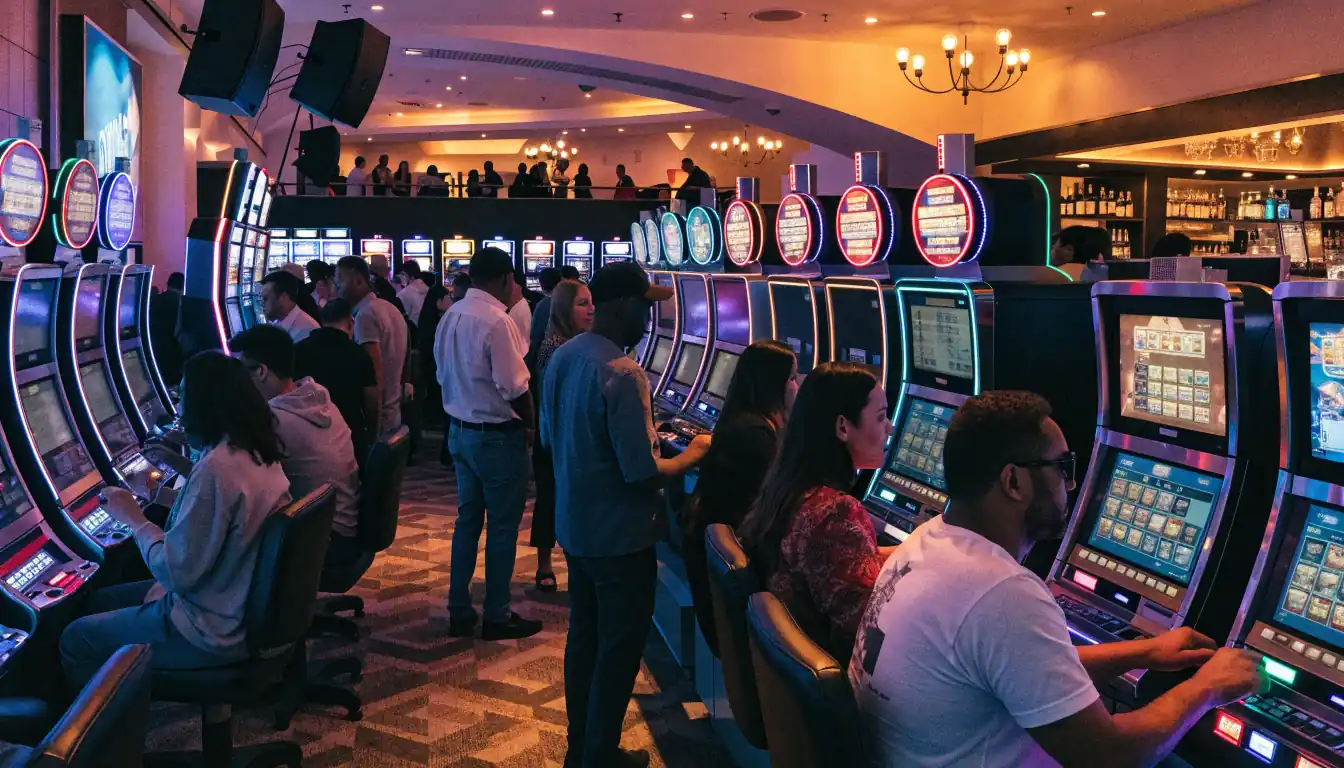
Zoom out to the whole country and, according to the same complyadvantage.com reporting, pokies generated $191.2 billion in Australian gambling turnover in 2023. Turnover isn’t profit and it isn’t loss — it’s total money cycled through the machines, bets going round and round as wins get replayed. But it’s still the figure that shows how central pokies are to the country’s gambling economy relative to every other product: sports betting, lotteries, racing, the lot.
The tax angle nobody explains properly
Here’s a detail that changes how people should think about "winning": gambling winnings are not taxed in Australia. If a machine pays out, whatever hits your balance is yours in full. There’s no need to declare it, no capital gains treatment, nothing.
That sounds like good news, and technically it is. But it’s also precisely why the government doesn’t need to tax player winnings — it’s already taking its cut somewhere else, upstream, from the venues and operators. In 2015-16, gambling revenue made up 7.7% of all state and territory taxation revenue. That’s not a footnote line item. That’s close to one dollar in every thirteen a state government raised through tax, coming from gambling activity. Pokies, given their share of gambling turnover, carry a large part of that load.
Tax Shift
The 7.7% share of state revenue comes from player losses, not from winnings, so the tax burden is effectively transferred onto losing players.
So when a state government talks about "responsible gambling initiatives" while pokies remain switched on in thousands of venues, it’s worth remembering which side of the ledger that 7.7% sits on. The tax isn’t gone. It’s just been moved to a spot where it’s collected from the losing side of the machine’s math rather than the winning side of an individual’s payout. Convenient, that.
What "the numbers tell you" actually means for a single session
None of this is a session-by-session prediction tool. Aggregate loss figures like AUD$12 billion or per-capita loss of AUD$608 describe the long run across the entire player population — they don’t tell you what will happen on the machine you sit down at tonight. That’s an important distinction, and it’s one the industry is happy to let blur.
What the aggregate numbers do tell you, reliably, is the direction of the tide. Over enough spins, across enough sessions, across enough machines, the money flows from players to venues at a rate that produces $12 billion in annual loss nationally and near-$2 billion in five-month profit for NSW clubs alone. Any individual session can run against that tide for a while. No trick, no betting pattern, no "hot machine" theory changes the direction the tide is actually running.

Compares withdrawal methods like PayID and crypto, explains KYC checks and manual review triggers, and…

I’ve heard the same handful of theories recycled at every venue I’ve worked near — that a machine "hasn’t paid in a while" and is therefore due, that playing max lines improves your odds of a bonus round, that cashing out and reinserting the same note resets something. None of that shows up anywhere in the loss and revenue figures above. If any of it worked in the way players hope, the aggregate numbers wouldn’t look like this. Machines wouldn’t post the kind of consistent net profit that let NSW clubs bank $1.945 billion in less than half a year. The math holds because the outcome of each spin isn’t influenced by the last one, and no player-side behaviour changes that.
Dragon Link, 5 Dragons, and the myth of the "better" game
People searching for tips on Dragon Link or 5 Dragons specifically are usually chasing something particular to those titles — bigger jackpot tiers, a "Hold and Spin" feature, the perception that these are somehow more generous machines because they’re more popular. Popularity and generosity aren’t the same thing, and there’s no published, verified data here breaking out per-title return rates for either game in the Australian market. I’m not going to invent a return-to-player figure to fill that gap, and any page that quotes you a precise RTP percentage for a specific title without naming where that number came from is doing exactly what it shouldn’t.
No RTP Data
There is no verified return‑to‑player data for Dragon Link or 5 Dragons in the Australian market, so any claimed RTP figures should be treated with scepticism.
What can be said honestly: these titles are popular precisely because they’re widespread across pubs and clubs, which is a function of licensing deals between game developers and venues, not a signal about better odds for the player. A machine’s prevalence on the floor tells you about the commercial relationship between operator and venue. It doesn’t tell you anything about what you’ll get back over time.
Reading the loss figures as a filter, not a warning label
I’d rather someone use the $608 per-capita loss figure as a filter for expectations than as a scare tactic, because scare tactics get tuned out fast and filters don’t. Here’s the filter version: if the machine population in this country is dense enough to represent 3% of the world’s pub and club units from 0.3% of the world’s people, and if that density has produced a five-month profit of $1.945 billion for one state’s clubs sector, then the "opportunity" being marketed to you isn’t an opportunity in the way a stock tip or a property deal is. It’s a fixed mathematical relationship between turnover and loss that’s been running long enough and at large enough scale to be measured in the billions, consistently, year after year.
None of that means winning individual sessions doesn’t happen — obviously it does, constantly, that’s what keeps machines running. It means the scale data isn’t decoration around the "real" tips. It is the actual answer to whether pokies are winnable in any sustained sense. Short answer: individual spins, yes, sometimes generously. The system as a whole, across the volumes Australia runs, no — not for the player, and not by accident.
The harm classification that doesn’t get quoted enough
There’s a specific finding worth sitting with rather than rushing past: poker machines are recognised as the most harmful form of gambling in New South Wales. Not equally harmful to other products. Most harmful. That classification isn’t a moral judgement bolted onto the numbers — it follows directly from the mechanics: rapid spin cycles, near-continuous play, machine density that puts a pokie within easy reach in almost any suburb, and a loss rate that compounds quietly across sessions rather than announcing itself in one dramatic moment the way a single bad sports bet might.
That’s the part of "what the numbers tell you" that a tips-and-tricks framing tends to skip. The tricks people search for — bet sizing, session length, machine selection — sit on top of a product that’s already been assessed, in the state with the country’s largest single concentration of machines, as the most harmful gambling format available. Any tip that doesn’t account for that starting point is incomplete before it’s even offered.
A short table, because the scale is easier to hold this way
| Metric | Figure | Period |
|---|---|---|
| National EGM turnover | ~AUD$150 billion | FY 2020-21 |
| National EGM player loss | AUD$12 billion | FY 2020-21 |
| Per-capita EGM loss | AUD$608 | FY 2020-21 |
| Australia’s share of world’s pub/club pokies | 3% (vs 0.3% of world population) | — |
| NSW pokie count | ~95,800 machines | — |
| NSW clubs’ net pokie profit | $1.945 billion | Dec 2017–May 2018 |
| Gambling revenue as share of state/territory tax | 7.7% | FY 2015-16 |
| National pokies turnover (per complyadvantage.com) | $191.2 billion | 2023 |
Look at that table the way I’d look at a set of house accounts, not a leaderboard. Every row is a version of the same fact stated a different way: this is a large, mature, tightly wired revenue system, and the player’s position inside it is structurally the same regardless of which state or venue they’re sitting in.
What this section isn’t claiming
It isn’t claiming winning is impossible — that would be false, and payout events happen constantly across such volume. It isn’t claiming every machine performs identically — differences between titles, jackpot structures, and venues clearly exist, though there’s no verified, machine-by-machine dataset here to name which specific units perform better or worse, and I won’t manufacture one. It isn’t claiming online pokies specifically operate under this same regulatory and revenue picture — the figures above describe the licensed pub, club, and casino EGM market; real-money online pokies aren’t legally offered to Australian residents under the Interactive Gambling Act, a distinction the next section addresses in more practical terms.

What this section is claiming, plainly: the scale data available on Australian pokies describes a system where aggregate player loss is large, consistent, and growing in nominal turnover terms year over year, and where that loss funds a meaningful share of state tax revenue. Any tip, trick, or strategy discussed afterward has to sit on top of that foundation, not replace it.
Practical tricks and responsible‑play safeguards for Australian pokies
Most lists of pokies tips and tricks promise a system. There isn’t one. What actually exists is a set of habits that keep the session under your control, and a regulatory machine running quietly underneath every machine you sit at, watching for something else entirely. I’ll deal with both, because they’re connected more than people think.
What "tricks" actually means here
Every pokie runs on a random number generator. No amount of timing, button-pressing rhythm, or "the machine’s due" thinking changes that. So when I talk about tricks, I mean session management — the only lever a player actually holds.
- Set a loss limit before you start.
- Use a personal timer for session length.
- Cash out winnings instead of reinserting them.
- Keep track of whole sessions, not individual spins.
- Prefer cashless/account‑based play where available.
- Chase losses by increasing bet size.
- Rely on myths like “the machine is due”.
- Play continuously without breaks.
- Assume higher‑profile titles pay better.
- Ignore self‑exclusion tools when you feel the need.
The habits that hold up:
- Decide the loss limit before you sit down, not during. Once credits are on the screen, judgement changes. Set the number while you’re still thinking clearly, away from the lights.
- Set a time limit and use a phone timer, not the venue clock. Venues don’t put clocks near pokies for a reason — there’s no reason to help them.
- Withdraw winnings rather than feeding them back in. If a win pushes the balance up, that’s the moment to bank it, not “let it ride.”
- Track sessions instead of individual spins. A single spin means nothing statistically. A session has a start, an end, and a number attached to it — that number is the only one worth remembering.
- Use cashless, account‑based play where it’s offered. These systems — sometimes called “transparent pokies” because the account trail replaces the anonymity of a coin slot — give you an actual record of what you put in and took out. Machines don’t lie about this the way memory does.
None of this improves the odds. It just stops the odds from working on you for longer than you meant to let them.
Self‑exclusion: the tool most players never open until they need it
BetStop, the national self‑exclusion register, launched in August 2023. Within six months it had 18,000 registered users. That’s a fast uptake for a scheme that asks people to voluntarily lock themselves out of an entire industry — and it tells you something about how many people were already looking for an exit before the tool existed.
Self‑exclusion isn’t a sign of failure. It’s closer to a pre‑commitment device — the same logic as setting a loss limit, just enforced by someone other than your own willpower at 11pm. I’ve watched enough people promise themselves "just till I’m even" to know that willpower is the least reliable control in the room.
If pokies play stops feeling like entertainment and starts feeling like a habit you’re managing rather than choosing, Gambling Help Online is the service built for that conversation — not a helpline as a last resort, but a first one.
The regulatory backdrop nobody advertises
The Interactive Gambling Act, passed on 28 June 2001, is the piece of legislation that shapes what’s legal to offer Australians online and what isn’t. It doesn’t touch land‑based pokies in pubs and clubs directly, but it sets the tone: harm minimisation first, commercial convenience second. Every rule that follows — venue caps, ID checks, self‑exclusion registers — sits downstream of that same instinct.
What’s less talked about, because it doesn’t sell memberships or bonus spins, is that pokies sit at the centre of Australia’s anti‑money‑laundering effort. Public inquiries and sector guidance have flagged pokies repeatedly as a major AML risk area — not because the machines are dishonest, but because they combine two things criminals want: high volumes of cash and limited traceability.
AML Checks
Venues may ask questions or request ID when they detect large cash insertions with minimal play, as part of anti‑money‑laundering monitoring.
How pokies get used for laundering — and why it matters to an ordinary player
I’ve sat through compliance briefings where this got spelled out in plain terms, and it’s worth spelling out here too, because understanding the mechanics explains half the "annoying" rules players run into at the counter.
The basic move is cash placement with minimal play: someone feeds a large amount of cash into an EGM, presses a handful of buttons, then cashes out almost immediately. The machine becomes a conversion tool — dirty cash goes in, a clean voucher or account balance comes out. Related typologies include:
- Purchasing winning tickets — buying someone else’s payout slip for cash, so the money now has a legitimate‑looking origin.
- Structuring across venues — spreading cash through multiple clubs or pubs in amounts small enough to avoid drawing attention at any single one.
- Collusion and weak oversight — staff or venue operators who look away, whether through negligence or arrangement, letting the pattern repeat.
None of this touches the odds of the machine. It’s a separate economy running alongside the game, and it’s the reason the person behind the counter sometimes asks questions that feel intrusive for someone who just wants to cash out $200.
Red flags venues are trained to watch for
Staff aren’t watching players for fun. They’re matched against a checklist that regulators and AUSTRAC guidance have built specifically around pokies behaviour. The indicators worth knowing, because they explain the scrutiny:
| Pattern | What it signals |
|---|---|
| Large cash insertions followed by minimal play and immediate cash‑out | Classic laundering conversion |
| Frequent small redemptions across multiple venues | Structuring to stay under reporting thresholds |
| Multiple patrons appearing to coordinate cash movements | Collusion between parties |
| Refusing ID or using several player cards | Attempt to break the paper trail |
| Redemption patterns well outside a venue’s normal average | Statistical outlier worth a second look |
| Access to more cash than expected for that customer’s profile | Mismatch between stated income and play volume |
| Depositing unusually high values relative to typical patron behaviour | Volume inconsistent with recreational play |
None of these are accusations against ordinary players. A retiree cashing out a modest win isn’t triggering anything. But if a session looks like one of these patterns — heavy cash in, near‑zero play, cash straight back out — expect questions, and expect them to be procedural rather than personal.
The controls sitting behind the counter
The tools venues and regulators lean on aren’t glamorous, but they’re the actual machinery of "safe pokies," more than any tip about bet sizing:
- Customer verification and patron profiling — matching behaviour against what’s expected for a given customer, over time, not just in one visit.
- Cashless and account‑based systems — the same “transparent pokies” infrastructure that helps a player track their own spend also gives venues and regulators an audit trail that cash never provided. It’s the rare case where player convenience and AML control point the same direction.
Venues running more than 15 machines carry heavier obligations again — a named compliance officer, formal risk assessments, an AML/CFT program, customer due diligence, and reporting of cash transactions above the threshold that triggers it. This is why the club with a bank of machines in the corner has more paperwork behind it than the pub with three.
What this means for how you actually play
I’ll put it plainly: none of the AML architecture is there to catch someone having a normal night out. It’s there because the volume of cash and the anonymity of play made pokies a soft target, and the industry got told — by inquiries, by AUSTRAC, by its own bad headlines — to close the gap. The side effect is a system that’s slowly getting more transparent, whether venues wanted that or not.
For a player, the practical takeaways sit in three places:
- Session limits and time limits are the only real “trick” — everything else is noise dressed up as strategy.
- BetStop exists, works, and doesn’t require a crisis to justify using it.
- Expect ID checks, account‑based systems, and occasional questions at the cashier — they’re not personal, they’re the visible edge of a much larger compliance obligation the venue can’t opt out of.
None of it changes what the machine pays out. It changes how much of your own behaviour you can see clearly while you’re sitting in front of it — which, in the end, is the only variable actually within reach.
Written by the editors at Casino Cities Guide.