
Best Casinos for Online Craps in Australia 2026
Understanding the Australian Regulatory Landscape for Online Craps
Craps doesn’t sit in its own legal category in Australia. It falls under the same umbrella as roulette, blackjack and slots — "online casino games" — and that umbrella is, on paper, closed to anyone offering these games to Australian residents. Before getting into odds, house edge or table etiquette, it’s worth understanding why the craps table you find at an offshore site exists in a different legal space than the sports bet you might place through a local bookmaker.
The law that actually governs this
The primary piece of Commonwealth legislation is the Interactive Gambling Act 2001 (IGA). It was introduced with a stated focus on harm minimisation — protecting the public rather than generating tax revenue directly from online casino products. Some sources refer to the same restrictions under the name "Interactive Gambling Act 1997," which prohibits provision of online casino games to Australian residents. Whether the 2001 date or the 1997 date is cited depends on the source; the substance is the same law doing the same job, and I’m not going to pretend one date quietly overwrites the other. Readers researching this further will run into both.
Before you place a bet on the dice at any online craps table, it pays to check how an operator handles licensing, payouts, and welcome offers, since those details shape the overall experience more than the game itself.
License: international iGaming licence – jurisdiction not named in the source · Bonus: 100% up to A$1,000 + 100 free spins, 35x wagering · Payout speed: PayID 1-24 hours · Min. deposit: A$30 (PayID from A$10) Operates under an international iGaming licence and pairs a sizeable welcome bonus with fast PayID withdrawals and a low minimum deposit via PayID, making it accessible for smaller bankrolls.
License: Curacao – Antillephone N.V. (Versus Odds B.V.) · Bonus: up to EUR 2,000 across 5 deposits + 200 free spins · Min. deposit: EUR 20 Licensed in Curacao, this operator spreads a large bonus package across multiple deposits, giving players an extended welcome offer rather than a single upfront perk.
License: Curacao eGaming OGL/2023/174/0082 (Dama N.V.) · Bonus: up to A$10,000 + 500 free spins across 4 deposits · Min. deposit: A$15 Holds a Curacao eGaming licence and offers a substantial multi-deposit bonus alongside a low minimum deposit requirement, making entry relatively easy.
Bonus: up to A$7,500 + 550 free spins across 10 deposits, 50x wagering · Payout speed: crypto under 1 hour, PayID 1-3 business days · Min. deposit: A$20 (A$30 to qualify for the bonus) Features a large bonus spread over many deposits with defined wagering terms, and stands out for quick crypto withdrawals alongside standard PayID processing times.
Bonus: 100% up to A$750 + 200 free spins, 35x wagering · Payout speed: crypto 30-120 minutes, fiat 24-72 hours · Min. deposit: A$30 Offers a solid welcome bonus with clear wagering requirements and notably fast crypto payout times, plus reasonably quick fiat withdrawals.
License: Curacao Gaming Control Board OGL/2023/176/0095 (Hollycorn N.V.) · Bonus: up to A$11,000 + 300 free spins (code NEO100) Licensed by the Curacao Gaming Control Board, this operator provides one of the larger bonus offers on the list, activated via a specific promo code.
License: Curacao Gaming Control Board (TechSolutions Group N.V.) · Bonus: 100% up to A$250 + 100 free spins (1st deposit) A Curacao-licensed operator with a straightforward first-deposit bonus, suited to players who prefer a simple, no-frills welcome offer.
License: Curacao Gaming Authority (Jumpman Gaming Ltd) · Bonus: up to A$6,600 + up to 250 free spins across 4 deposits Licensed under the Curacao Gaming Authority, it offers a generous bonus spread across several deposits, giving newcomers value over multiple top-ups.
License: Curacao OGL/2024/1335/0780 · Bonus: up to A$1,000 + 150 free spins, wager-free · Min. deposit: EUR 20 Holding a Curacao licence, this operator’s standout feature is a wager-free bonus, which removes the usual playthrough hurdle for bonus funds.
License: Curacao eGaming (Hollycorn N.V., since 2017) · Bonus: 225% up to A$1,540 + 600 free spins across 4 deposits, 20x wagering · Min. deposit: A$20-30 (depends on the offer) Backed by a long-standing Curacao eGaming licence, it delivers a high percentage match bonus across multiple deposits with moderate wagering requirements.
What the IGA actually prohibits is specific: online casino-style games, including slots, poker, blackjack, roulette — and by extension, craps — cannot be legally offered to people in Australia. Online sports betting is a different story. It’s legal under state and territory licences, which is why you’ll see local bookmakers advertise freely while no local operator advertises an online craps table.
There’s a detail here that gets glossed over constantly, usually by people with a reason to gloss over it: the law targets operators, not players. It is illegal to offer online casino gambling in Australia, and it is not possible to obtain a domestic licence to run an online casino at all. But an individual Australian placing a bet at an offshore-licensed site isn’t breaking the IGA by doing so. This is the gap the entire offshore online casino industry lives in — not a loophole exactly, more a one-way street. The site can’t legally exist here. The player isn’t the one committing the offence for using it.
That distinction matters because it changes what "safety" can even mean in this market. There’s no domestic licence to check, because domestically licensed real-money online casino operators offering craps to Australians don’t exist. None. So when something claims to be "properly licensed" for Australian online craps, the honest question is: licensed by whom, and does that licence have any actual reach here?

In-play betting: a specific carve-out worth knowing
One rule that trips people up: live, in-play online betting is illegal under the same framework. You can’t legally place a bet on an event after it’s started, through an online interface, from Australia. But live betting by phone is legal — a distinction that only makes sense if you remember the IGA was written to target a delivery mechanism (the internet), not the act of betting itself. It’s the kind of asymmetry that looks bizarre until you realise the law was drafted around a specific technology, not around gambling harm in the abstract. Craps doesn’t have an "in-play" element in the sports-betting sense, but it’s worth knowing this distinction exists elsewhere in the same Act, because it shows how narrowly and literally these prohibitions are drawn.
Who actually regulates what
Australia doesn’t have one gambling regulator. It doesn’t have one gambling law, either. Regulation is split between the federal government and each state and territory, and none of these bodies has full authority over the whole picture.
At the federal level, the Australian Communications and Media Authority (ACMA) is the body that enforces the IGA. Its main enforcement tool isn’t prosecuting individual gamblers — it’s going after the infrastructure. Since November 2019, ACMA has had the power to order internet service providers to block access to illegal offshore gambling sites. That’s blunt but effective at the margins: block the domain, and the average player has to go looking for the next one.
The figures for blocked illegal gambling sites are only estimates; the number can change as new offshore operators appear and others are taken down.
The scale of this enforcement is worth naming, with the caveat that the number keeps moving and depends on which report you’re reading. One legal-industry source (iclg.com) put the tally, as of August 2025, at 1,296 illegal gambling sites and affiliates blocked since 2019, with 220 illegal services voluntarily exiting the Australian market. A separate industry source (boomaff.com) cites a similar figure — over 220 illegal gambling services ceasing operations because of ACMA’s enforcement actions — without necessarily agreeing on the exact site-blocking count. I’m citing these as reports, not as an official running total, because ACMA’s own published figures shift with each update and I’d rather flag that than hand you a stale number dressed up as current fact.
Below the federal layer, every state and territory runs its own regulator, and they don’t have identical mandates:
- The Victorian Gambling and Casino Control Commission (VGCCC) monitors wagering service providers — including ones based in other states — for compliance with the National Consumer Protection Framework.
- Liquor & Gaming NSW performs a comparable role in New South Wales.
- The Northern Territory Racing Commission (NTRC) occupies an unusual position: it’s described as Australia’s de-facto online gambling regulator, not because of any special federal mandate, but because it licenses most of the national online bookmakers, who are drawn to the Territory by a lower tax rate. That’s a regulator whose influence comes from where operators choose to incorporate, not from any authority granted over the whole market.
Land-based casinos are a separate matter entirely. Crown Melbourne — the largest casino in the Southern Hemisphere, and the most visible physical craps table in the country — answers to state government regulators and law enforcement, not to ACMA. The federal apparatus built around the IGA has nothing to do with how a physical casino floor is licensed and inspected. Two different regulatory worlds, two different sets of rules, and it’s easy to blur them if you’re not paying attention to which "casino" is actually being discussed.
None of these state and territory bodies has meaningful reach over an operator sitting on a server offshore. VGCCC and Liquor & Gaming NSW can regulate what happens inside their borders and can lean on domestically licensed wagering providers. Against a site licensed in Malta or the UK and hosted outside Australian jurisdiction, their power is limited. That’s not a gap anyone is hiding — it’s just the practical result of a regulator’s authority stopping at a border that the internet doesn’t respect.

Why there’s no registry to check
On many markets, the standard piece of advice is "check the operator’s licence in the regulator’s public register." That advice doesn’t translate here, and repeating it as if it does would be misleading rather than cautious. There is no domestic licence for online casino games — craps included — so there’s no register listing which operators are "approved" to run an online craps table for Australians, because approving one would itself be illegal. Any craps table reachable from an Australian IP address is, by definition, operating under a licence issued somewhere else — commonly bodies like the Malta Gaming Authority or the UK Gambling Commission — for a market that isn’t Australia. That licence is real, and it does mean something about how the operator is supervised. It does not mean an Australian regulator has looked at that operator and signed off on it for local players, because no Australian regulator does that job, ever, for this category of game.
Illegal Offering
Under the Interactive Gambling Act it is illegal to offer online casino games, including craps, to Australian residents.
This is worth being blunt about because "licensed" gets used as a marketing word constantly, and it’s doing quiet work it hasn’t earned. A site can be entirely honest when it says "licensed" and still mean something narrower than what an Australian reader assumes. Licensed where, to serve whom, is the actual question — and the honest answer, for online craps reaching Australia, is always "not here."
What enforcement has actually achieved
It’s tempting to read the site-blocking numbers as a story of steady progress toward a clean market. The reality is messier. ACMA’s blocking orders and the voluntary exits reported by industry sources represent real enforcement activity — sites do get blocked, some operators do walk away rather than deal with an unfriendly jurisdiction. But the same reporting that documents hundreds of blocked domains also implicitly documents an industry that keeps producing new ones. Blocking a domain doesn’t retire the operator; it usually just retires that particular URL. This is the standard cat-and-mouse dynamic in any jurisdiction that bans a product people still want, and Australia’s online casino market — craps tables included — is a textbook case of it.

None of this changes the legal position for a player. Visiting an offshore-licensed craps table isn’t something an individual is prosecuted for; the enforcement machinery is built to squeeze operators and access points, not users. But it does mean the market a reader encounters when searching for "online craps Australia" is a market operating in spite of the law, not because of it — and the number of sites blocked so far isn’t a sign the problem is shrinking on any predictable timeline. It’s a sign the pattern repeats.
Where responsible-gambling obligations fit in
None of this regulatory patchwork means gambling is banned outright in Australia — it’s legalized, just heavily compartmentalised by product and by jurisdiction. Sports betting and lotteries run through licensed local operators with real oversight. Online casino games, craps among them, sit outside that structure entirely for Australian residents, served only by operators licensed elsewhere.
There is no Australian domestic licence register for online casino games, so operators are licensed elsewhere and not overseen by local regulators.
That structural gap is exactly why harm-minimisation messaging matters more here, not less. When a regulator has genuine oversight of an operator, it can impose things like mandatory self-exclusion tools, deposit limits, and enforced identity checks before withdrawals. Offshore operators serving the Australian market aren’t bound by Australian rules on any of that — whatever protections they offer are a function of their own licensing body, not of anything Australia can require of them. A player looking for a support resource that isn’t tied to any specific operator’s incentives can reach out to Gambling Help Online, which operates independently of the casino side of the table entirely.
The regulatory picture in one place
| Layer | Body | Actual reach over online craps |
|---|---|---|
| Federal | ACMA | Enforces the IGA; blocks offshore sites at the ISP level; no licensing role for online casino games because none can be licensed |
| Federal | Interactive Gambling Act 2001 | Prohibits offering online casino games (craps included) to Australian residents; targets operators, not players |
| Territory | Northern Territory Racing Commission | Licenses most national online bookmakers (sports betting), not online casino/craps operators |
| State | VGCCC (Victoria) | Monitors wagering providers for consumer-protection compliance; limited power over offshore casino sites |
| State | Liquor & Gaming NSW | Equivalent role in NSW; same jurisdictional limits offshore |
| State | Land-based casino regulators | Oversee physical venues like Crown Melbourne; entirely separate from ACMA’s online remit |
The takeaway isn’t that online craps is unreachable in Australia — plainly it is reached, given how much enforcement effort goes into blocking it. The takeaway is that "reachable" and "regulated for you" are two different things, and the gap between them is where a reader’s own judgement has to do the work no regulator is positioned to do.
How Craps Games Work and What to Expect from Online Providers
Craps looks chaotic to anyone standing at a table for the first time — dice flying, a dozen betting spots painted across green felt, dealers calling numbers in shorthand. Strip away the noise and the mechanic underneath is simple: one player rolls two dice, everyone else bets on what happens next. Online, that mechanic gets rebuilt inside a random number generator, and the felt becomes a screen. The bones of the game stay the same; what changes is who’s running the wheel of chance behind the curtain.
The Come-Out Roll and the Point
Every round starts with what’s called the come-out roll. The shooter — whoever’s turn it is, or in a single-player online game, the software itself — throws the dice for the first time in a new round.
Three outcomes settle things immediately:
- 7 or 11 — this is a “natural.” Anyone who bet on the Pass Line wins straight away.
- 2, 3, or 12 — this is “craps.” Pass Line bets lose on the spot.
- Any other number (4, 5, 6, 8, 9, or 10) — this becomes “the point.” The number is marked, and the game moves into its second phase.
Once a point is established, the shooter keeps rolling. The goal now is to roll that same point number again before rolling a 7. Roll the point — Pass Line bets win. Roll a 7 first — they lose, and the round is over; a new come-out roll starts the cycle again.
That’s the entire skeleton of the game. Everything else — the dozens of side bets, the odds bets, the proposition bets scattered around the layout — is built on top of this one core sequence.
Reading the Bets
The betting map on a craps table is where most newcomers freeze. In practice, only a handful of bets matter for anyone playing seriously, online or off.
Pass Line is the default bet, the one tied directly to the come-out roll and the point, described above. It’s the bet nearly every player at a physical table makes, and it’s usually the first one presented in an online interface too.
A software‑generated random number decides the dice outcome; graphics are purely cosmetic.
A real table with physical dice is streamed to the player; outcome is seen live on camera.
RNG games require only software development, making them widely available.
Live‑dealer games rely on visual verification of real dice, while RNG games depend on third‑party certification.
Don’t Pass is the mirror image — betting against the shooter. It wins when the Pass Line loses, with one small exception most tables build in (a 12 on the come-out is usually a push rather than a win for Don’t Pass, so the house keeps its edge on both sides of the table).
Come and Don’t Come bets work like a Pass/Don’t Pass bet that can be placed after the point is already set, letting a player start their own mini-round mid-game.
Odds bets are the one corner of the table where the house has no built-in edge at all. Once a point is established, players can back their Pass or Don’t Pass bet with an additional wager that pays out at true odds — no distortion, no skew. It’s the only bet on the layout that’s mathematically neutral, which is exactly why floor staff rarely bring it up unprompted and why online interfaces sometimes bury it a menu deep. Nobody in this business highlights the bet that doesn’t feed the hold.
Place bets let a player wager directly on a specific number showing up before a 7, without needing a point already established on that number. Convenient, but the payout is calibrated so the house keeps a cut.
Proposition bets — the one-roll bets like Any 7, Snake Eyes, or Yo (11) — sit at the center of the table and pay the highest multiples. They’re also where the built-in disadvantage to the player is steepest. These bets exist because they’re exciting, not because they’re good value. Worth knowing before the dice are even in your hand.


From Physical Dice to Digital Outcomes
The obvious question with any online casino table game: if there’s no physical dice hitting a real table, what’s actually generating the number?
Two structures exist, and they produce genuinely different experiences.
RNG-based craps is the more common online format. A random number generator — shortened to RNG in every serious discussion of the mechanic — produces the dice outcome the same way it produces a card draw or a reel spin: a mathematical process certified to distribute results according to the game’s stated odds, running with no physical dice at all. The graphics on screen showing dice tumbling are cosmetic. The actual outcome was decided the instant the RNG produced its number.
Live dealer craps is built differently. A real table, real dice, a real dealer, filmed and streamed to players logged in from wherever they are. This format is far rarer for craps than it is for blackjack or roulette — craps requires physical space for a full table layout and enough concurrent players to make a live stream worthwhile for an operator, which is a harder business case than a single live blackjack seat. Where it exists, it plays close to the pace and feel of a physical casino floor, minus the crowd noise.
How to Verify an Offshore Operator
Look for the licensing body mentioned on the site, such as the Malta Gaming Authority or the UK Gambling Commission.
Find the licence number and use the regulator’s online register to ensure it is active.
See whether the operator offers self‑exclusion tools, deposit limits, and independent dispute resolution.
Contact the support team during business hours to gauge response speed and professionalism.
For a player deciding which to look for, the practical difference comes down to trust mechanics rather than gameplay feel. An RNG game asks a player to trust the certification behind the software. A live dealer game asks a player to trust their own eyes, watching real dice land on a real table through a camera feed. Neither is inherently more honest — they’re just different chains of verification.
RTP: What the Number Actually Tells You
Return to player — RTP, in the shorthand everyone in the industry actually uses — describes the theoretical percentage of all wagered money a game returns to players over a very large number of rounds. It is not a promise about any single session, any single shooter, any single night at the table. It’s a long-run average, calculated across volumes no individual player will ever personally reach.
Craps as a table game has a mathematical structure that’s unusually transparent compared to most casino products, because the odds on each bet type can be calculated directly from dice probability rather than estimated from a hidden algorithm. A Pass Line bet’s disadvantage to the player is fixed by the mathematics of the two dice; a proposition bet’s disadvantage is fixed the same way. In principle, nobody needs to guess.

In practice, RTP figures published for individual digital craps products don’t always match that clean math, because the number quoted depends on which bets are included, how the software rounds its calculations, and what the provider chooses to disclose. According to one industry review of digital table products, a provider’s craps title was quoted with an RTP of 94% — a figure worth treating as a single data point about one product, not as a benchmark for the game generally. Craps RTP varies by which bets are in play far more than most other casino games, and any single published number is describing one specific implementation, not the game itself.
The honest approach for anyone comparing online craps products: check what RTP figure the specific title publishes, and treat a number from one provider as information about that provider — not as the going rate for craps everywhere.
What a Craps Table Actually Looks Like at Scale
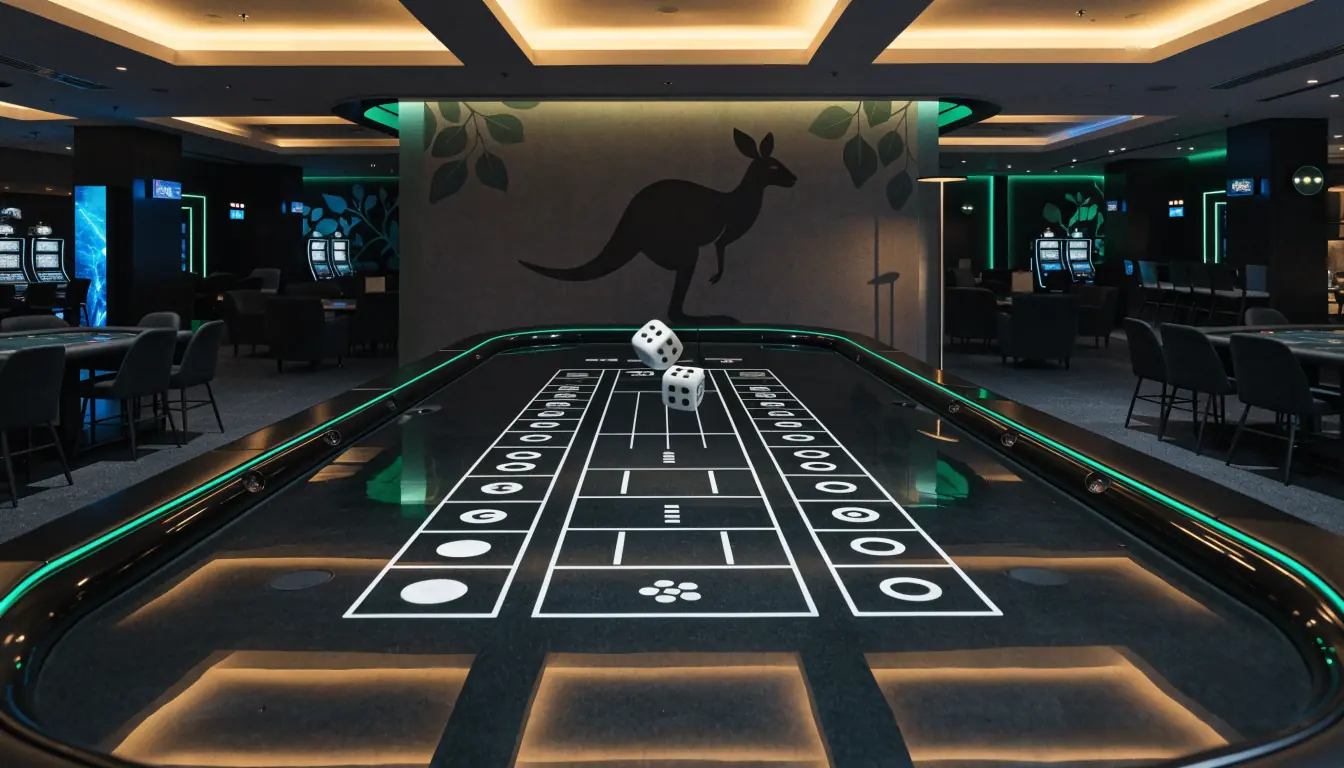
Physical craps tables are large, and the game’s presence in a casino tends to say something about how seriously that venue takes its table games program. Crown Melbourne — the largest casino in the Southern Hemisphere — runs craps tables as part of a wider table games floor, which gives some sense of the physical footprint the game demands: a full craps layout takes more staff and more space than a blackjack pit of the same size, which is part of why smaller venues, and a good number of online operators, skip it in favor of simpler table games.
Helpful Resource
Players who need support can contact Gambling Help Online, an independent service that operates regardless of the operator’s location.
That physical scale question doesn’t disappear online — it just changes shape. Building a genuine live-dealer craps stream, with a full-size table, correct camera angles on the dice, and staff trained specifically on this game, is a bigger production commitment than adding another slot title or another blackjack variant. That’s a large part of why craps shows up less often in live-dealer lobbies than the other classic table games. RNG versions carry no such constraint, since there’s no physical table to film — which is one reason the RNG version of the game is more widely available than the live one.
Support: What "24/7" Usually Doesn’t Mean
Online casino marketing leans hard on the phrase "24/7 support" — it appears in footers and FAQ pages as a kind of background hum, repeated so often it stops registering as a claim at all. Worth pausing on, because it isn’t universally accurate.
Customer support at online gambling operators is not available around the clock as a rule. Live chat coverage, phone lines, and email response times vary from operator to operator, and a claim of continuous availability printed on a landing page doesn’t guarantee a human is on the other end at 3am on a Tuesday. Some operators do run genuinely continuous coverage; plenty run business-hours coverage with an auto-responder filling the gaps overnight, and call it 24/7 anyway because the login page itself never goes offline.

For a game like craps, where a player might be juggling multiple simultaneous bets and wants a fast answer about how a specific proposition bet resolved, the actual responsiveness of support matters more than it does for a simple slot spin. Before relying on support to sort out a dispute on a live shooter’s round, it’s worth checking — not assuming — what hours are actually staffed, and through what channel.
A Quick Reference on Odds by Bet Type
The table below sets out the basic structure of the main craps bets, without inventing payout ratios that aren’t in the public record for any specific operator. What’s constant across every legitimate implementation of the game is the mechanical relationship between the bet and the dice outcome — that part of the game is pure mathematics and doesn’t change from one provider’s software to the next.
| Bet type | Triggered by | House edge relative to other bets |
|---|---|---|
| Pass Line | Come-out roll and point | Among the lowest on the table |
| Don’t Pass | Mirror of Pass Line | Among the lowest on the table |
| Odds (backing Pass/Don’t Pass) | Placed after point is set | None — paid at true odds |
| Come / Don’t Come | Mid-round version of Pass/Don’t Pass | Similar to Pass/Don’t Pass |
| Place bets | Direct bet on a number | Higher than Pass Line |
| Proposition bets | Single-roll outcomes | Highest on the table |
The practical takeaway from that structure: the bets that look the most "boring" on the layout are the ones with the fairest math, and the bets that promise the biggest immediate payout are the ones the house is least generous about. This isn’t a secret, exactly — it’s printed on every payout chart. It’s just rarely the part of the table a new player’s eye goes to first.
What to Actually Check Before Sitting Down at a Digital Table
Given the above, a short mental checklist is more useful than a long one:
- Whether the game is RNG-based or live-dealer, since that determines what kind of trust mechanism is actually verifying the outcome.
- What RTP figure the specific title publishes, treating it as a fact about that title rather than the game as a whole.
- What support hours are actually staffed, rather than what’s printed in the marketing copy.
- Which bets on the layout carry the lowest disadvantage to the player, since that structure doesn’t change between operators even when the presentation does.
None of this requires expertise beyond reading what’s already in front of a player. It just requires reading past the parts of the page designed to be skimmed.
Playing Real‑Money Craps Online: Risks and Legal Considerations
Real-money craps, in its online form, sits in a legal grey zone that catches most players by surprise. No domestic operator can hold a licence to offer it — the game falls into the same bucket as slots, roulette and online poker, all of which are prohibited under federal law when supplied to Australian residents. What the law does not do is criminalise the player. Betting real money on craps at an offshore-licensed site is not an offence for the individual sitting at the keyboard. The exposure sits entirely with the operator, not the customer.
That distinction matters, but it doesn’t make the practicalities disappear. Any operator taking Australian players for real-money craps is doing so from outside the country, under a licence issued somewhere else. There’s no domestic register to check it against — the concept of "verify the operator" doesn’t apply here the way it does for a sportsbook licensed by a state regulator. What’s left is judging the operator on what it actually publishes: identity checks before withdrawal, clear terms before any bonus is credited, a working complaints process, and contact details for independent dispute resolution. If those aren’t visible, that’s the answer.
"Secure" and "trusted," printed on a landing page, describe nothing. They’re marketing copy sitting next to a deposit button. What describes something is whether the site asks for ID before it pays out, whether it lists wagering terms before or after you’ve claimed the offer, and whether support exists to answer a dispute — bearing in mind that support, even on well-run sites, isn’t staffed round the clock.
For anyone whose play is becoming a problem rather than entertainment, Gambling Help Online is available regardless of where the operator sits.
Step‑by‑Step Guide to Playing Craps in a Land‑Based Australian Casino
None of the federal back‑and‑forth about the Interactive Gambling Act — whether you trace it to the 1997 version or the 2001 rewrite — touches what happens on the casino floor. That legislation targets operators offering games over the internet. A physical table at a licensed venue like Crown Melbourne sits entirely outside it.
Getting to the table:
- Have ID ready. Age verification at the door is standard, and the legal minimum is 18.
- Change cash for chips at the cage — table games run on chips, not cards or apps.
- Watch a round before joining. Craps has its own rhythm of calls and hand signals; standing at the rail for a few rolls saves embarrassment.
- Place a Pass Line bet to start. It’s the simplest entry point and staff will walk you through timing if you ask.
- Follow the dealer’s instructions on when to bet and when to wait — the stickman controls the dice, not you.
No login screen, no support ticket. Just the table.
Are crypto casinos legal in Australia in 2026?
No operator can legally offer online casino games — including crypto casinos — to Australian residents under the Interactive Gambling Act 2001, and no domestic licence exists for them. However, the law targets operators, not players, so an individual Australian using an offshore-licensed crypto casino is not breaking the IGA.
What is the process of applying for a Licence for a Relevant Product?
There is no such process for online casino products: it is not possible to obtain a domestic licence to run an online casino in Australia at all. Licences are only available for online sports betting, issued at state and territory level — with the Northern Territory Racing Commission licensing most national online bookmakers.
What are the key limits on providing services to customers?
Online casino-style games (slots, poker, blackjack, roulette, craps) and live in-play betting over the internet are prohibited federally, while online sports betting is legal under state/territory licences. Live betting is only permitted by phone, not through an online interface.