Best 5-Reel Slots in Australia: What Actually Matters
 Available in AU
Table of Contents
- What Is a 5‑Reel Slot?
- Classic 5‑Reel Slot Machines vs Modern Online Versions
- Online 5‑Reel Slots in Australia: RTP, Volatility and Player Experience
- Playing 5‑Reel Slots for Real Money: Australian Legal Landscape
- Free No‑Download 5‑Reel Slot Bonuses: What to Expect
- How to Play 5‑Reel Slots Online – Platforms and Tips
- Terminology: Games, Machines and Slot Variants
What Is a 5‑Reel Slot?
Five reels means five vertical columns of symbols spinning independently, arranged across a set number of rows to form the grid where winning combinations land. That’s the whole definition. Everything else — themes, bonus rounds, "wild" symbols — sits on top of this structure, not inside it.
Three-reel machines, the old mechanical style, offer fewer symbol combinations and simpler paylines. Add two more reels and the math changes: more positions, more ways to line up matching symbols, more room for the game designer to build in bonus triggers. That’s the practical difference between reel counts — not "better" or "worse", just a different combination space.
None of this touches what actually determines whether a machine pays well. Reel count shapes how a game looks and how combinations form. Return to player — the percentage of wagered money a machine returns over time — is a separate figure entirely, and it moves inversely to the house edge. A five-reel layout with poor RTP is still a poor bet. Reel count and payback are two different questions.
Before spinning the reels on any 5-reel slot title, it helps to know how each casino handles licensing, bonuses, deposits and payouts, since these details shape the real value behind the games on offer.
License: international iGaming licence – jurisdiction not named in the source · Bonus: 100% up to A$1,000 + 100 free spins, 35x wagering · Payout speed: PayID 1-24 hours · Min. deposit: A$30 (PayID from A$10) Holds an international iGaming licence and offers a matched deposit bonus with free spins under a 35x wagering requirement, plus fast PayID payouts within a day and a low minimum deposit option.
License: Curacao – Antillephone N.V. (Versus Odds B.V.) · Bonus: up to EUR 2,000 across 5 deposits + 200 free spins · Min. deposit: EUR 20 Licensed in Curacao under Antillephone N.V., this casino spreads a sizeable welcome bonus with free spins across five deposits, keeping the entry deposit modest.
License: Curacao eGaming OGL/2023/174/0082 (Dama N.V.) · Bonus: up to A$10,000 + 500 free spins across 4 deposits · Min. deposit: A$15 Operating under a Curacao eGaming licence via Dama N.V., it backs a large multi-deposit bonus package with free spins and a low minimum deposit requirement.
Bonus: up to A$7,500 + 550 free spins across 10 deposits, 50x wagering · Payout speed: crypto under 1 hour, PayID 1-3 business days · Min. deposit: A$20 (A$30 to qualify for the bonus) Offers an extensive bonus spread across ten deposits with free spins under 50x wagering, and stands out for fast crypto payouts alongside quick PayID processing.
Bonus: 100% up to A$750 + 200 free spins, 35x wagering · Payout speed: crypto 30-120 minutes, fiat 24-72 hours · Min. deposit: A$30 Provides a 100% matched bonus with free spins under 35x wagering, and moves funds quickly through both crypto and fiat payout channels.
License: Curacao Gaming Control Board OGL/2023/176/0095 (Hollycorn N.V.) · Bonus: up to A$11,000 + 300 free spins (code NEO100) Licensed via Hollycorn N.V. under Curacao’s Gaming Control Board, it offers one of the larger bonus packages with free spins, activated by a bonus code.
License: Curacao Gaming Control Board (TechSolutions Group N.V.) · Bonus: 100% up to A$250 + 100 free spins (1st deposit) Regulated by the Curacao Gaming Control Board through TechSolutions Group N.V., it keeps things simple with a straightforward first-deposit bonus and free spins.
License: Curacao Gaming Authority (Jumpman Gaming Ltd) · Bonus: up to A$6,600 + up to 250 free spins across 4 deposits Licensed by the Curacao Gaming Authority under Jumpman Gaming Ltd, it spreads a substantial bonus with free spins across multiple deposits.
License: Curacao OGL/2024/1335/0780 · Bonus: up to A$1,000 + 150 free spins, wager-free · Min. deposit: EUR 20 Licensed under Curacao’s OGL framework, it offers a wager-free bonus with free spins, a rare feature that reduces the strings attached to bonus funds.
License: Curacao eGaming (Hollycorn N.V., since 2017) · Bonus: 225% up to A$1,540 + 600 free spins across 4 deposits, 20x wagering · Min. deposit: A$20-30 (depends on the offer) An established Curacao-licensed operator via Hollycorn N.V. since 2017, offering a high-percentage bonus with free spins across several deposits under a relatively low 20x wagering requirement.
Classic 5‑Reel Slot Machines vs Modern Online Versions
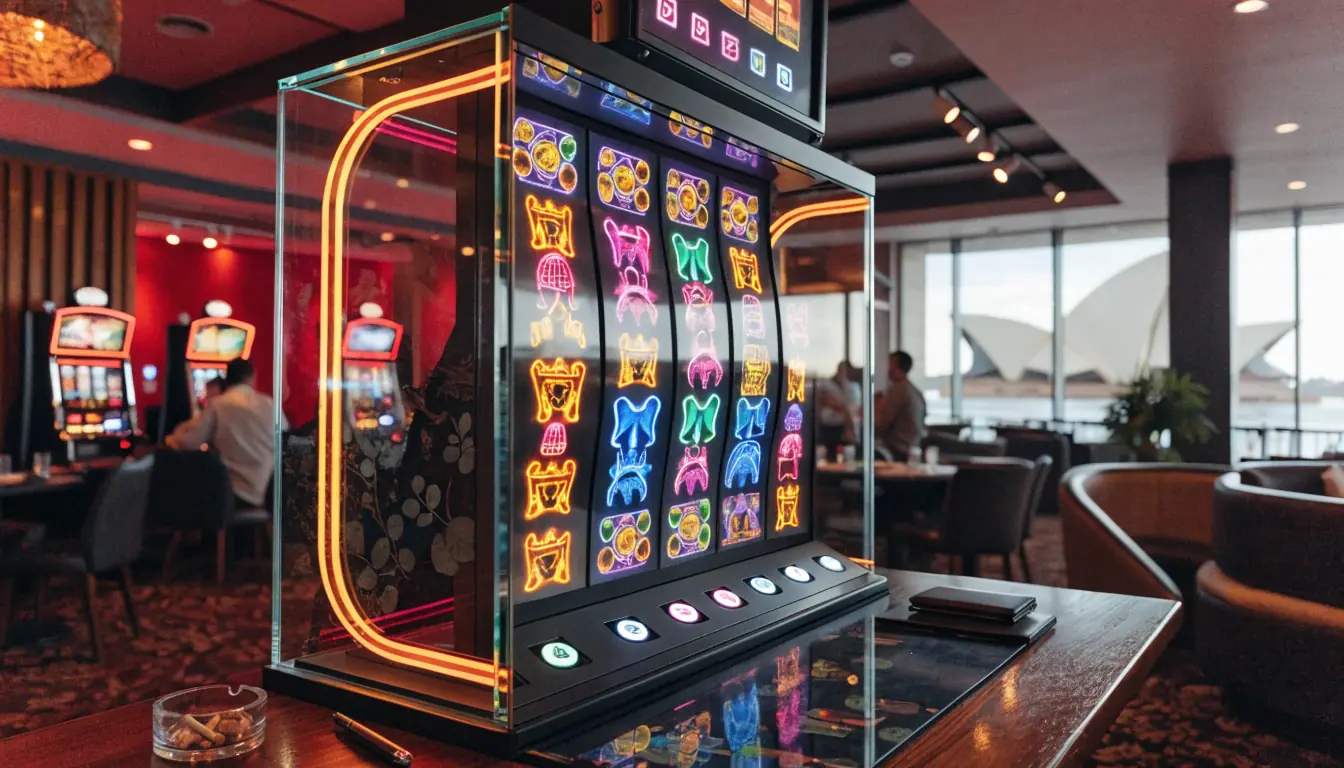
A mechanical five-reel cabinet on a casino floor and a classic five-reel slot machine you load on a laptop share a layout, not much else. The old floor units were physical: coin trays, a lever or button, mechanical reels that had to physically stop where the machinery landed them. What looked random wasn’t quite the same thing as what runs behind an online game today. Each spin on a modern version is generated by an RNG, and each spin is independent — nothing about the last result feeds into the next one. The cabinet-era machines had their own mechanical constraints; the outcome was still effectively unpredictable to a player, but the engineering behind "unpredictable" has changed completely.
Availability is where the split really shows. A physical five-reel machine exists in one place, takes up floor space, and gets played by one person at a time. A browser or app version exists everywhere at once. That changes the pace of play more than people expect — no queue, no walk to the machine, no closing hours. It also changes how sessions actually go. On the floor, a losing streak was a physical thing: money in trays, cash running low, a natural stopping point. Online, that friction is gone, which is exactly why the number stamped on the game — its RTP — is worth reading twice.
Here’s the distinction that matters in either format: the built-in, "theoretical" RTP is a long-run figure, calculated across a scale of spins no single player will ever reach. What a player actually sees over one sitting — the "experienced" RTP — can look nothing like it, in either direction. Volatility sits on top of that. It’s the pattern of how wins land: frequent and small, or rare and large. A classic-style five-reel game and its online descendant can carry the same paytable and still feel completely different to play, purely because of how volatility shapes the swings along the way.


Online 5‑Reel Slots in Australia: RTP, Volatility and Player Experience
RTP gets thrown around in casino marketing like it settles an argument. It doesn’t, not on its own. Return to player is the percentage of wagered money a slot is built to pay back over time — a 96% RTP slot is designed to return about $96 for every $100 wagered, calculated across the full life of the game rather than any single session. Nobody runs a slot machine long enough by hand to prove that number, so it isn’t measured — it’s simulated. Developers run millions or billions of computer spins against the game’s paytable and reel weightings, then let probability-weighted outcomes settle into a figure. That figure gets locked into the game code before a single real player touches it.
House-edge percentage is just RTP looked at from the other side of the counter. The two are inverse values — if a game returns 96%, the house-edge percentage is what’s left over. Marketing departments almost never lead with the house-edge percentage. They lead with RTP, because 96% sounds like generosity and 4% sounds like a fee. Same number, different door.
Theoretical RTP vs What You Actually See
Here’s where the number stops being useful in the way people want it to be. Theoretical RTP is the built-in percentage — the one from the simulation, tested across a sample size no individual will ever come close to playing. Experienced RTP is what a player actually walks away with after a session that lasts minutes or hours, not millions of spins.
A short session can land nowhere near the theoretical figure, in either direction. That’s not a flaw in the number — it’s what "theoretical" means. I’ve watched players quote a game’s RTP back to a dealer like it was a receipt for money owed. It isn’t. It’s an average built from a sample size no lifetime of play will ever match.
A high RTP does not guarantee a profit in a short session, and nothing in how these numbers are calculated changes that. Treat the percentage as a description of the machine, not a prediction of the next hour.
How a Slot’s RTP Actually Gets Set
The math behind RTP is plain enough once you see it worked through. If a slot takes $110,000 in total bets and pays back $100,000 in winnings, its RTP for that stretch is 90.9%. Run that same calculation across a large enough number of spins with fixed reel weightings and paytable values, and the number stabilises into the figure printed in the game’s information screen.
Regulatory certification requires third-party verification of that figure before a game reaches players — an outside lab reruns the simulations independently rather than taking the developer’s word for it. In Australia, game information often includes these RTP values specifically so players have something concrete to check rather than a vague promise of "fair odds." That’s a consumer protection, not a courtesy.
One detail worth sitting with: the same slot title can carry different RTP versions at different operators. BGaming, for instance, states this directly about its own catalogue — a game isn’t necessarily locked to one payback figure across every site that offers it. I don’t take that as proof every provider does the same thing; it’s one company describing its own setup. But it’s a reason to check the number on the specific game screen in front of you rather than assume it matches what you read in a review somewhere else.
Land-Based vs Online: Why the Numbers Differ
Online slots have higher RTP than land-based slots as a general pattern, and the reason is mostly about overhead. A physical cabinet on a casino floor carries costs a web-hosted game doesn’t — rent, staff, security, the electricity to keep a room full of machines running. Some of that gets built into the payback figure.

Crown Perth publishes a floor-wide minimum: all slot machines on site carry an RTP of at least 90%. That’s a floor, not a typical figure — plenty of machines sit above it — but it’s a useful anchor. Compare that minimum to the industry benchmark for online RTP, which sits around 96%, with anything above considered high RTP and anything below considered low. A land-based minimum of 90% and an online benchmark of 96% aren’t measuring different things — they’re measuring the same thing in two environments with different cost structures.
Progressive jackpot slots complicate this further. They often carry lower RTP because a slice of every wager gets diverted into the jackpot pool rather than the regular payout structure. The "low RTP" isn’t a design flaw — it’s the mechanism. Someone eventually wins a number large enough to make the maths of everyone else’s smaller returns beside the point, at least for them.
Volatility: The Other Half of the Picture
RTP tells you how much a game gives back over a long run. It says nothing about how that money arrives. That’s volatility — it describes the win pattern: how often payouts land and how big they are when they do.

A game can carry a respectable RTP and still feel brutal to play, because volatility governs the shape of the ride, not the destination. Low volatility means frequent, modest wins — the balance ticks along without much drama. High volatility means long stretches of nothing punctuated by payouts big enough to matter. Two slots can share a nearly identical RTP and play like completely different products because their volatility sits at opposite ends of the scale.
A handful of BGaming titles illustrate the spread well, since the provider publishes both figures side by side:
| Game | RTP | Volatility |
|---|---|---|
| Cat’s Soup | 98.06% | Medium |
| Golden Paw: Hold & Win | 97% | Medium |
| Blazing Fire Pots Hold & Spin | 96.27% | Medium‑high |
| Always Up! x10000 | 96.05% | Very high |
| Aztec Clusters | 97% | Very high |
| Merge Up™ 2 | 97% | Very high |
Look at that table and the point makes itself. Aztec Clusters and Cat’s Soup carry almost the same RTP, but one is described as very high volatility and the other medium — meaning the actual experience of playing them, session to session, has little in common. A player chasing frequent small wins and one chasing a rare large hit would want opposite ends of that list, regardless of which RTP figure is technically higher.
None of these figures are mine to verify independently — they come from the provider’s own published data, current at the time it was checked. Providers update RTP configurations, and a title can carry a different number at a different operator, so treat the table as a snapshot of how one company describes its own games, not a permanent ranking.
Where RNG Fits Into All of This
None of the numbers above mean anything without a random number generator doing its job underneath them. RNG is the mechanism that ensures each spin is independent — the outcome of one spin has no memory of, and no influence over, the next. There’s no such thing as a machine that’s "due" for a win, and no pattern in past spins that predicts the next one. The RTP and volatility figures describe long-run tendencies built into the maths; RNG is what keeps any individual spin from being anything other than random within that maths.
I’ve heard players describe a "cold" machine like it had a temperament. It doesn’t. What feels like a streak is just variance doing what variance does — clustering unevenly even when every event is independently random. That’s not a criticism of anyone for feeling it. It’s just not information about the machine.
Reading a Slot’s Numbers Before You Play
Between RTP, volatility and the theoretical-versus-experienced gap, there’s a reasonable checklist for sizing up a 5-reel title before committing any time to it:
- Check the published RTP on the game’s own information screen. Given that the same title can carry different figures at different operators, the number on the specific game in front of you is the one that matters, not a figure remembered from another site.
- Note the volatility rating alongside it. A high RTP with very high volatility plays nothing like a similar RTP with medium volatility — the second number tells you what a session will actually feel like.
- Treat theoretical RTP as a long-run average, not a session forecast. It describes millions of simulated spins; a real session is a tiny, noisy sample of that curve.
- Look for the industry-benchmark comparison. Around 96% is the general online reference point — figures meaningfully above that are on the high side, meaningfully below are on the low side.
- Remember progressive jackpots trade RTP for upside. A lower baseline figure on a jackpot title isn’t a mistake in the game’s design — it’s the cost of funding the prize pool.
None of this is a system for beating a game. It’s a way of reading what the game is, in plain terms, before money changes hands.
The Legal Backdrop Worth Knowing Before Any of This Applies
Everything above describes how RTP and volatility work as mechanics — genuine features of how these games are built and certified. It’s worth being direct about the legal setting those mechanics sit inside, because Australian law treats online slots differently from how a casino floor treats them.
The Interactive Gambling Act 2001 is the Commonwealth law governing online gambling in Australia, built around harm minimisation. Under it, online casino-style games — slots, poker, blackjack, roulette — are prohibited from being offered to Australian residents by operators. Some sources reference an earlier Interactive Gambling Act 1997 covering the same prohibition; the two references don’t fully agree on which year the operative Act dates to, and it’s worth naming that inconsistency rather than picking one version and presenting it as settled. What’s consistent across both is the substance: providing online casino games to Australian residents is against the law.
Illegal Offering
Providing online casino slots to Australian residents is prohibited by the Interactive Gambling Act, and operators offering them can face serious penalties.
That prohibition targets operators, not players. It’s not illegal for an individual in Australia to play at an offshore-licensed online casino. The law was written to stop companies from offering these games domestically, not to criminalise someone spinning a reel. Online sports betting sits in different territory entirely — it’s legal under state and territory licensing, a separate regulatory lane from casino games, poker, and in-play betting, all of which remain prohibited federally.
The next section covers what that legal landscape actually means in practice for real-money play. Worth flagging here only because RTP and volatility are honest, checkable facts about a game’s mechanics — the legal status of where that game is offered is a separate fact, and one that doesn’t bend just because the maths on the paytable is sound.
Playing 5‑Reel Slots for Real Money: Australian Legal Landscape
Ask around a casino floor long enough and someone will eventually ask whether spinning a 5-reel slot online for real money is even legal in Australia. The honest answer takes more than a yes or no.
The Interactive Gambling Act 2001 (IGA) is the Commonwealth law that governs this. It wasn’t written to police individual players — it was built around harm minimisation, and its actual target is the supply side of the industry. Under the IGA, online casino-style games — slots, poker, blackjack, roulette — are prohibited. Not "restricted." Prohibited.

Here’s the part that trips people up: prohibited for whom.
The IGA makes it illegal to provide these games to Australian residents. It doesn’t make it illegal for an Australian resident to play them. That distinction sounds like a technicality. It isn’t — it’s the entire legal structure. The law was drafted to go after operators, not the person sitting at home with a phone and a login.
So no domestic online casino can legally offer you a 5-reel slot for real money. That’s settled. What’s left unsettled — deliberately, by the shape of the law itself — is your own position as a player using an offshore-licensed site. Individual Australians playing at offshore operators aren’t breaking the IGA. The obligation, and the exposure, sits with whoever is running the game, not with whoever is spinning it.
What this actually means day to day
- No operator can be domestically licensed to run online casino slots for Australian players. That licence doesn’t exist, because the activity it would cover is exactly what the IGA blocks.
- Playing at an offshore-licensed site isn’t a criminal act for the player. The law simply wasn’t written to reach that far.
- There’s no local regulator issuing “approved” casino operators to check against, because there’s nothing to approve.
That last point matters more than it looks. Any site telling you to "check the operator’s licence" as if a register exists is dressing up a gap as a safeguard. There’s nothing to check here — not because oversight failed, but because the licence category itself was never created for this market.
None of this is a workaround or a loophole someone found. It’s the plain text of legislation aimed at suppliers, leaving player conduct in a space the Act never tried to regulate. Real, but narrow.
Worth remembering before the next section, which gets into free-play offers: legality of access and fairness of a game are two separate questions. This section answers the first.
Free No‑Download 5‑Reel Slot Bonuses: What to Expect
No‑download play means the 5‑reel game runs in a browser, nothing installs, nothing gets saved locally. That’s the whole appeal — open a tab, spin, close it. No account history, no real balance at stake.
What "free" doesn’t change is the math underneath. The RTP built into a game stays the same whether the credits are play‑money or real. A slot engineered to return around $96 for every $100 wagered runs that same ratio in demo mode — the simulation doesn’t know it’s free.
Worth knowing: online slots generally carry higher RTP than their land‑based counterparts. So a no‑download version of an online 5‑reel game gives a reasonably honest preview of the return profile you’d see if the same title were played for stakes elsewhere — assuming that’s legally available to you at all.
One caveat, short: demo sessions are too brief to prove anything. RTP is a long‑run average, not a promise for the next ten spins.
How to Play 5‑Reel Slots Online – Platforms and Tips
Picking a platform for 5-reel slots online starts with checking what sits behind the "certified fair" badge most sites display. That badge means a third party has verified the RTP claims — not just taken the provider’s word for it. Worth remembering: the RTP figure quoted anywhere isn’t a guess. It comes from running the game through millions or billions of simulated spins before it ever reaches a real reel.

Beyond that, there’s not much mystery to the mechanics. Set a bet size that matches how many spins you actually want to get through, not how much you’re hoping to win. Read the paytable before the first spin, not after a session goes sideways — it tells you which symbols carry the weight and which are filler.
One habit worth keeping: treat every session as separate. RNG outcomes don’t remember your last spin. Neither should your bankroll plan.
Terminology: Games, Machines and Slot Variants
Ask three people in the industry what a "slot game" is versus a "slot machine" and you’ll get three slightly different answers. None of them are wrong. The terms overlap because the hardware and the software used to mean the same thing, and habits from the pub floor never quite left the vocabulary.
Machine originally meant the physical cabinet — reels, lever, coin slot, the works. On an online site there’s no cabinet, but the word stuck around because "machine" still signals something mechanical and fair in players’ minds. What’s actually running behind a "5-reel slot machine" listed on a website is software: a random number generator producing the outcome of every spin, independent of whatever happened on the last one. No memory, no pattern, no machine in the physical sense at all.

Game is the more accurate term for the online version, and it’s what regulators and providers use in technical documentation. A game is a defined set of rules — reel layout, paylines, symbols, bonus triggers — wrapped around that RNG engine. When a provider releases a "new slot game," they mean new math and new art, not new hardware.
Slot variant covers the different structural approaches to the same basic idea. A few terms worth knowing:
- Classic slot — fewer reels, simpler paylines, styled after the mechanical originals.
- Video slot — the umbrella term for most modern 5-reel titles, built entirely in software with animated bonus features.
- Progressive slot — a version where part of every wager feeds a shared jackpot pool, which changes the payout math compared with a fixed-prize game.
- Cluster-pay or ways-to-win slot — a structural variant that drops the fixed payline model altogether, though it’s still commonly described using reel counts for comparison.
Where this matters is in reading the numbers a game displays. RTP and house edge are inverse values — a game’s RTP tells you what’s returned over time, the house edge is what’s kept, and they always add up to the same total. The RTP figure itself isn’t a guess; it comes from probability-weighted outcomes calculated across every possible result the game’s math model can produce.
Two RTP figures get used loosely and interchangeably, which causes most of the confusion:
| Term | What it means |
|---|---|
| Theoretical RTP | The built-in percentage from the game’s math model |
| Experienced RTP | What a player actually sees across a limited session |
The first is fixed. The second bounces around — sometimes wildly — because a short session is a small sample, not the full picture the theoretical number is built from.
Volatility is a separate measurement entirely, and providers list it alongside RTP for a reason. It describes win patterns — how often a game pays and how large those payouts tend to be — rather than how much it returns overall. Two games can share the same RTP and feel completely different to play, because one clusters small frequent wins and the other saves everything for rare, larger hits.
None of this vocabulary is decoration. Knowing the difference between "machine" as a figure of speech and "game" as the actual product, or between theoretical and experienced RTP, changes how a player reads every number on a game’s information screen elsewhere in this guide.
Can operators change RTP after a game goes live?
The RTP figure is locked into the game code before players ever access it, based on simulations run across millions or billions of spins. Regulatory certification also requires third-party verification of that figure, which adds another layer against unadvertised changes.
How do recommended online casinos ensure game fairness?
Fairness relies on RNG technology, where each spin is generated independently and unaffected by previous results. RTP figures are also verified by third-party labs that rerun the developer’s simulations before a game reaches players, and this data is often published so players can check it themselves.
What security features must licensed casinos have?
Licensed casinos rely on RNG systems to keep spins independent and unpredictable, and their games undergo third-party RTP verification before release rather than relying solely on the developer’s own testing.
Written by the editors at Casino Cities Guide.